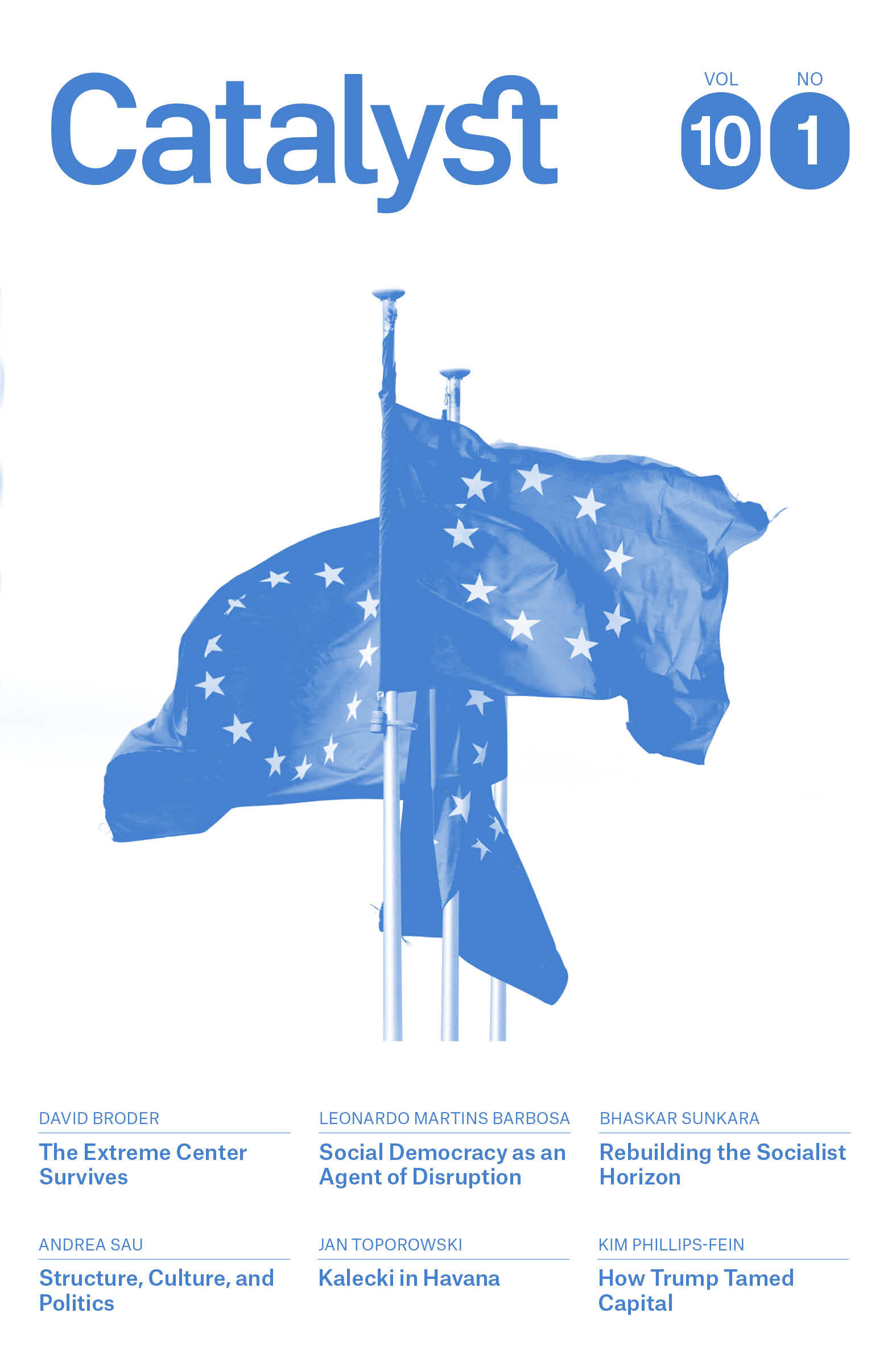
The ebbs and flows of socialist politics, from classical social democracy to the contemporary “third way” left to Cuban socialism, frame this issue. David Broder takes up the recent evolution of what Tariq Ali famously called the “extreme center” — erstwhile social democratic parties that have morphed into overseers of neoliberal orthodoxy. Whereas Ali had suggested that these parties might lose their popularity in the wake of the 2008 global financial crisis, Broder diagnoses why, far from declining, they survived and even consolidated their hold on power.
Social democracy’s mutation into parties of order and discipline is in sharp contrast with their historical legacy as mobilizing agents whose power rested on the threat of disruption. Against some contemporary depictions of this history, Leonardo Barbosa reminds us of the myriad ways the classical parties of the working class accumulated the power resources needed to install social democratic institutions. Meanwhile, elsewhere in the issue, Catalyst publisher Bhaskar Sunkara offers a view of the rise and fall of both social democracy and state socialism in the twentieth century and why a socialism after capitalism must remain the horizon of any Left worth its name.
The construction of earlier working-class institutions depended to some measure on the hard work of identity creation and the consolidation of an internal culture for labor and its broader coalition. Even while Marxism has always been anchored in its materialism and a structural analysis of capitalism, it has recognized the crucial role of culture in the creation of working-class identity. Andrea Sau offers a theoretical account of how culture, structure, and the economy interact in working-class politics.