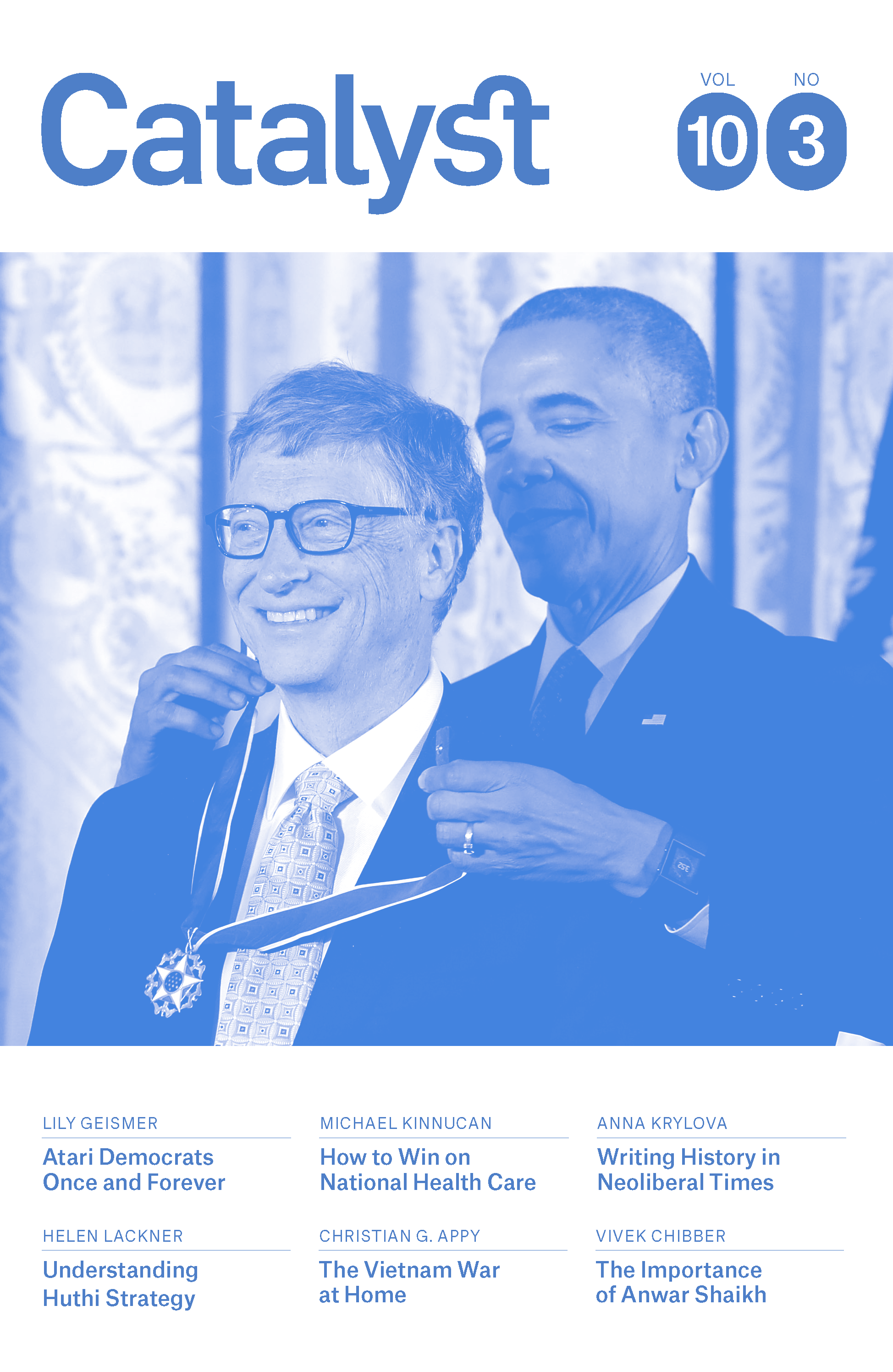
Ever since Donald Trump’s second inauguration, it has been well known that he has actively courted and won the support of leading elements of the burgeoning technology sector. But as Lily Geismer points out in her essay in this issue, it was the Democrats who diligently wooed this sector starting in the Clinton administration and continuing all the way through the Biden years. This was part of the party’s broader turn away from the New Deal coalition, centered on urban manufacturing and trade unions. Having decided that that coalition was no longer viable, Democrats actively pursued an alliance with Big Tech, knowing full well that doing so meant they would have to break their relationship with the trade unions. This means that even as they try to displace Trump and his fragile coalition, Democrats will most likely return to chasing Big Tech, the very sector that has been behind some of Trump’s most reactionary policies.
If the Democrats are going to reclaim an enduring relationship with the working class, the most obvious route is to push ahead with one of the most popular demands in political culture today, which is for some kind of national health care system. Since 2016, the most widely circulated proposal has been Bernie Sanders’s call for Medicare for All. But in a provocative essay, Michael Kinnucan argues that national health care should not automatically be interpreted as Medicare for All. In fact, he argues, however desirable the plan may be, it is most likely politically infeasible. Instead he proposes a combination of price and spending controls, which has the benefit of splitting the political opposition to Medicare for All and making national health care politically realizable.
One of the refreshing developments on the Left in recent years has been the return of political analysis and the recentering of capitalism. This might seem an odd statement, since this orientation was always the hallmark of the radical intelligentsia, and the historical discipline always played a central role in this endeavor. But as Anna Krylova documents in her sweeping essay, the neoliberal era witnessed a profound transformation of historical research in which it professed a nouveau radicalism, while descending into a debilitating turn away from materialist and structural frameworks — the two indispensable foundations of radical critique. The result, she argues, was a discipline that brandished all the verbiage of radicalism while offering little of substance.
As Trump’s unprovoked war with Iran drags on, a recent turn has been the Huthi attacks on Saudi Arabia, which are widely interpreted as being launched at the behest of the Iranian regime. But as Helen Lackner points out in an interview, there are compelling domestic pressures behind the attacks, connected to the insurgent regime’s increasingly tenuous hold on its regional power. Indeed, Lackner argues, a perception that the attacks are being carried out on behalf of Iran would actually reduce Huthi support, already teetering due to the human costs of the US sanctions.
Christian Appy’s review of Mitchell K. Hall’s important new history of the movement against the Vietnam War, Waging Peace, recovers some of the political and cultural contributions of that era. Appy appreciates Hall’s excavation of the movement’s role in ending the war. But he suggests that the author might have done more to illuminate and even appreciate the radical wings of the activist left, who, despite their follies, displayed deep commitments and organizational innovations in pressing their demands.
And finally, we publish a short obituary of Anwar Shaikh, the preeminent radical economist of our time. Shaikh was not only a surpassingly brilliant scholar but a deeply committed intellectual who did more than perhaps anyone since Karl Marx to put Marxist economics on a scientific footing. We can only hope the emerging left can attract talent of his caliber, as its predecessor did.