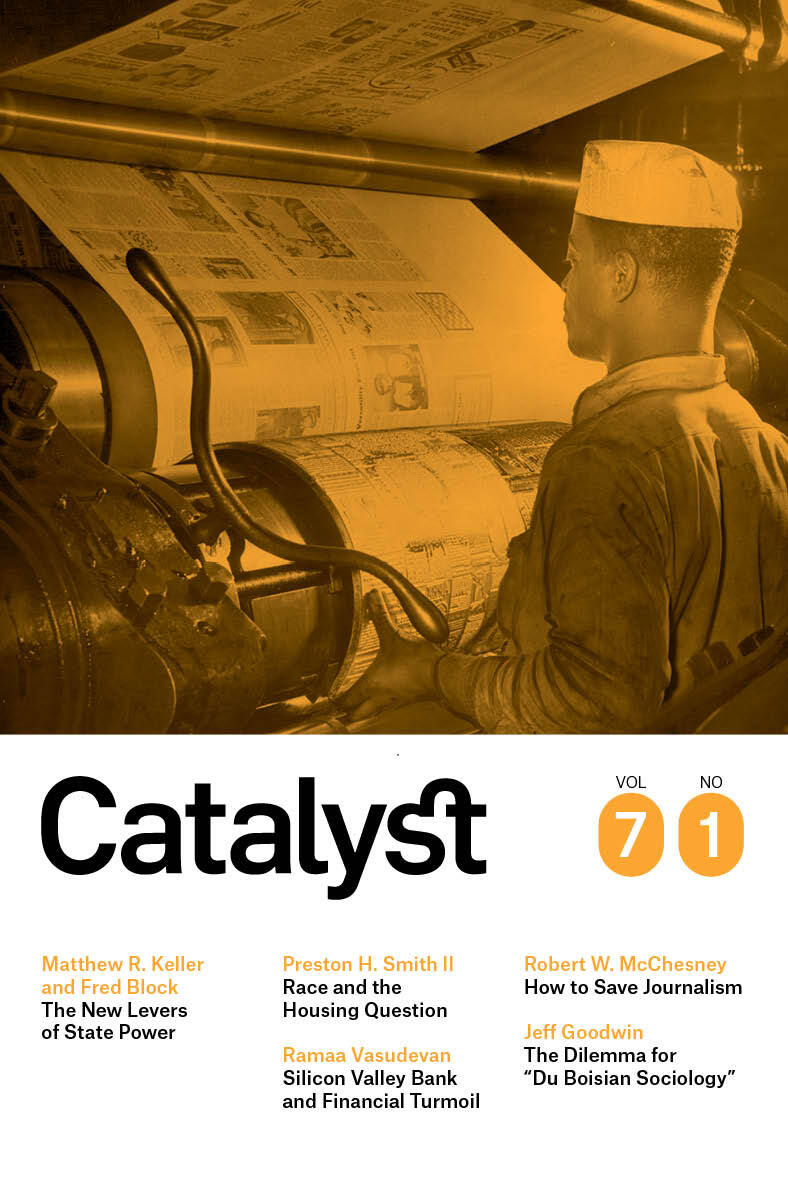
This issue of Catalyst focuses on prospects for reform in contemporary capitalism. In the opening essay, Matthew R. Keller and Fred Block argue that significant segments of American capital are now so dependent on state support that planners have real political leverage over them. Indeed, business leaders are aware of this, and it is one reason they are aggressively undermining democratic institutions — to block any possibility of popular forces bending the state to their will and using it to discipline capital. This new landscape gives the Left real openings to restructure the national economy, while also raising the stakes for US capital to forestall any such change.
In a complementary piece, we sit down with prominent media scholar and activist Robert W. McChesney to discuss reform models for journalism. It is no secret that American journalism is in free fall. McChesney proposes a model of publicly funded, locally controlled news outlets that might replace the advertising-based model that has dominated for more than a century — and that seems to be on its final legs.
While McChesney outlines how we might reform one sector, Ramaa Vasudevan describes how the banking “reforms” following the 2008 financial crisis contributed to the wave of bank failures of the past months, starting with Silicon Valley Bank and radiating outward into the wider sector. Vasudevan argues that, in some ways, President Joe Biden’s reaction simply repeats the familiar pattern of Washington bailing out Wall Street — but with the added twist that Silicon Valley appears to have entered the partnership as a major player.