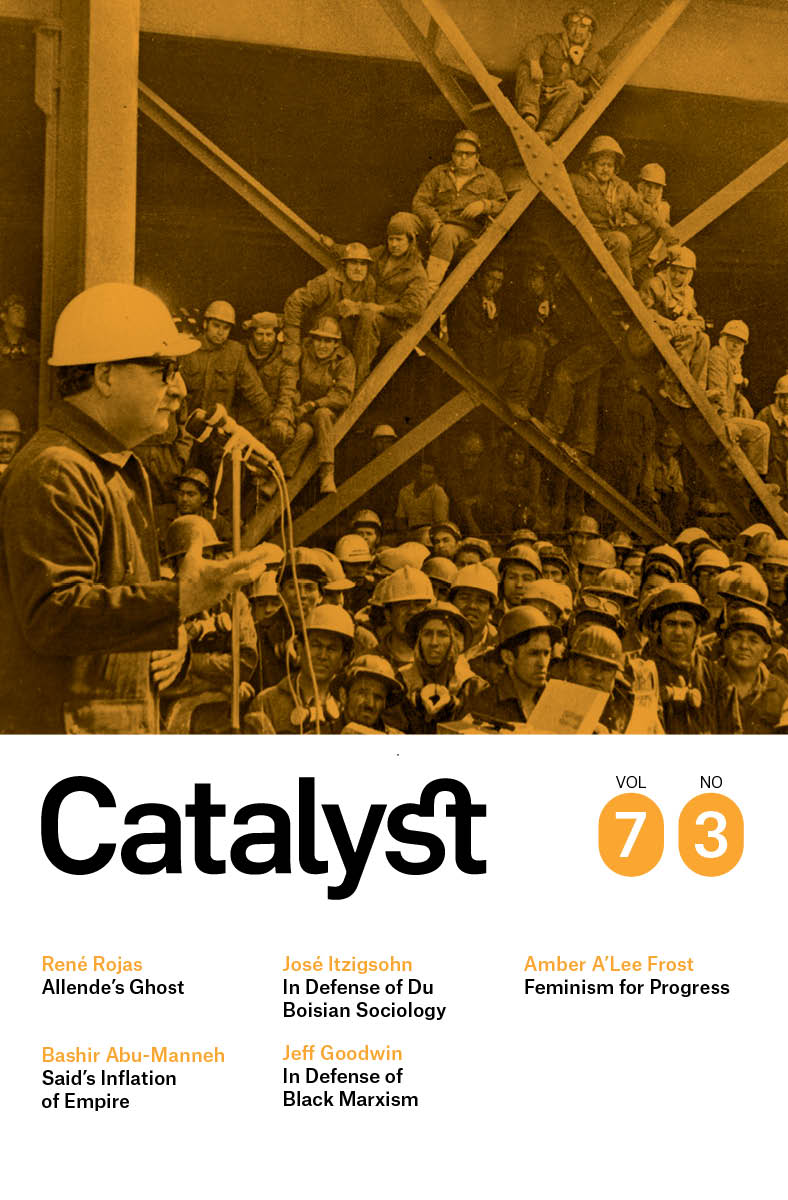
Fifty years ago, Chile’s road to socialism suffered a devastating defeat. On September 11, 1973, the Chilean military — spurred by elites, condoned by middle-class sectors, and backed by Washington — toppled Salvador Allende’s Unidad Popular (Popular Unity, UP), a vibrant but strained coalition government helmed by the Communist and Socialist parties. The coup, which global progressives recently commemorated, smashed workers’ organizations, popular movements, and democratic institutions, murdering thousands and sending orders of magnitude more to torture centers, concentration camps, and internal and international exile. In ushering in a seventeen-year dictatorship and laying the groundwork for thirty years of post-authoritarian free-market supremacy in Chile, it also seemed to eliminate one of the most promising experiments from working-class arsenals. The defeat of Allende’s socialist government, just three fast-paced years after its jubilant inauguration, appears to have crushed democratic socialist aspirations the world over. In the ensuing half century, why have socialists not replicated Chilean workers’ electrifying struggle?
To many radicals today, the UP’s road to socialism, the extraordinarily complex endeavor to build an “institutional apparatus of a new form of pluralistic, free socialist order,” as Allende put it, was doomed from the beginning.1 According to the dominant interpretation, the UP had to either moderate its aims and accommodate elites in order to survive, or abandon all compromise and sharpen the class struggle to accelerate decisive confrontation. Both options portended failure: slowing the process of change in pursuit of conciliation was capitulation; speeding it up toward a final showdown was suicide. After half a century, we must move beyond this dichotomized, and paralyzing, analysis of the UP’s alleged impasse.
One way to evaluate the Chilean road to socialism is by contrasting its trajectory with that of its present-day heirs. Just over fifty years after Allende’s 1970 triumph at the polls, Gabriel Boric, heading a new left alliance known as Apruebo Dignidad with the same Communist Party that anchored the UP, won runoffs following a second-place finish in the November 2021 elections. Both in the ’70s and today, promising radicals in power have succumbed to their opponents halfway into their mandates. Yet while brutal military intervention crushed the UP, Boric’s Apruebogovernment, built around the generation of radical activists spawned by the ground-shaking 2011 student movement and propelled to power in the aftermath of Chile’s 2019 mass rebellion, finds itself overtaken by a rising reactionary right after just two years in office.