The US-Israeli genocide of Palestinians continues to roil global affairs. But since the publication of our previous issue, one of the most significant developments has been the eruption of a massive wave of protest on university and college campuses across the United States. These protests are notable for several reasons, the most obvious of which is the hysterical, violent, and punitive response from the authorities — on top of which we now see the accusation of antisemitism reach the point of genuine absurdity. The protests hearken back to the student movement against South African apartheid a generation ago and, before that, the protests against the Vietnam War. But the action on the part of college presidents and police is far more aggressive than anything we had seen at this stage of the earlier waves. These are symptoms of an educational system that has only the thinnest connection to its stated mission and is far more attuned to the demands of the donor class and to a political culture where the assault on civil liberties is absorbed with hardly a blink. Joe Biden, who is running on a platform as the last defense against impending fascism, is not only aiding and abetting a genocidal campaign in Gaza but tamping down on democratic rights at home, extinguishing basic freedoms, and engaging in a kind of demagoguery we have not seen in generations.
Understanding the social forces behind these transformations, both in the United States and abroad, is an urgent task. In our lead article, Guy Laron offers a pathbreaking analysis of the political and economic forces behind the rise of Benjamin Netanyahu. He makes it amply clear that, while Netanyahu is harnessing a political coalition of recent provenance, the economic project driving the accelerated occupation is by no means unique to him but rather is shared across the political spectrum. Over to the east, the country of Pakistan is seeing another iteration in the cycle of violence and political clampdown by its military. Umair Javed analyzes how Imran Khan, once the chosen representative of Pakistan’s oligarchs, has lost favor with them — and somehow become the symbol of Pakistani mass movements.
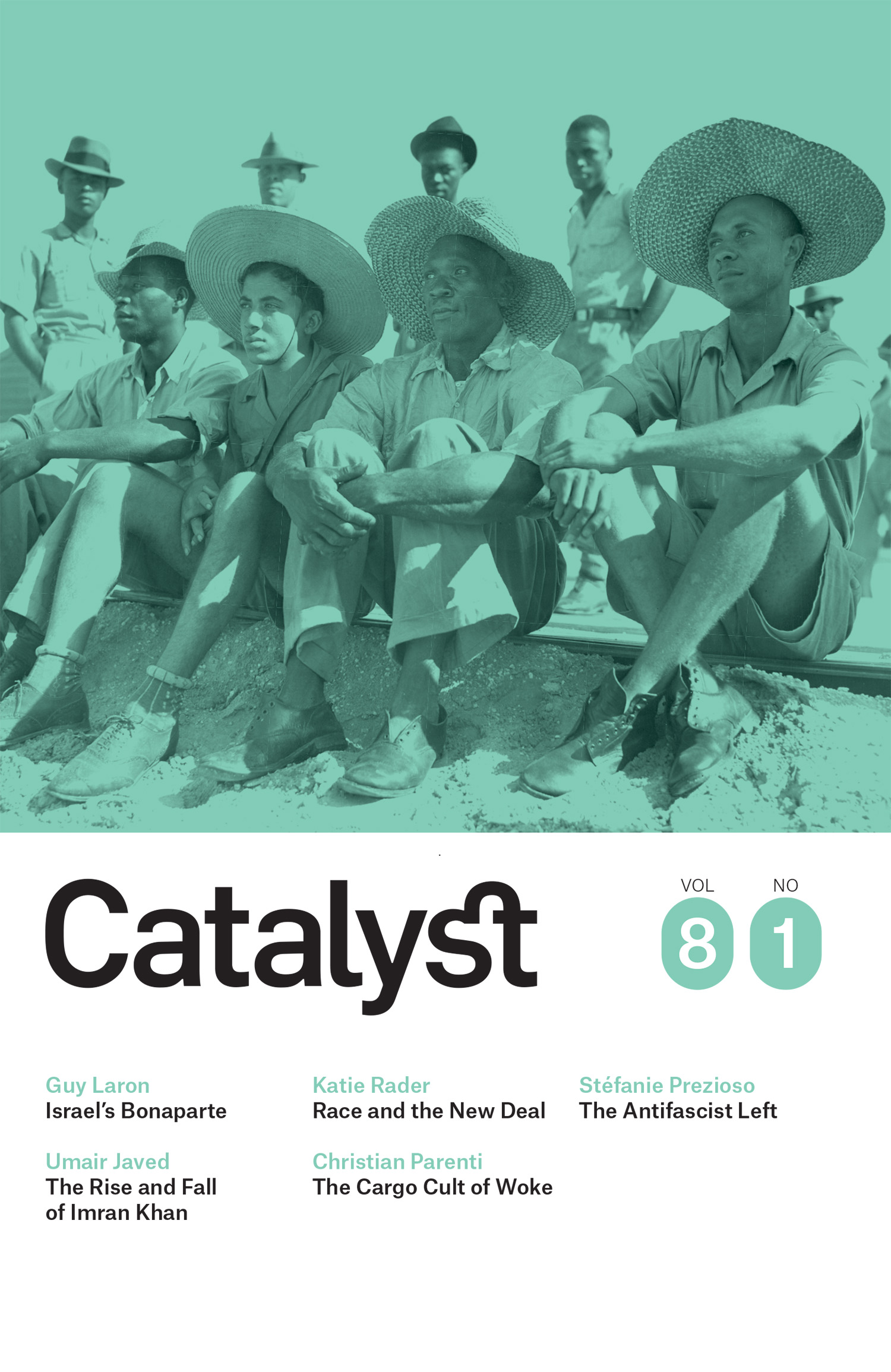
Closer to home, Katie Rader takes up one of the most influential recent arguments in the literature on the New Deal. Whereas Franklin D. Roosevelt’s legislative transformations were once seen as a giant step forward for working people — black and white — they have recently been denigrated as another instance of white supremacy. Rader examines some of the most widely cited texts making this argument and shows that not only do they fail to make their case but that their own evidence counts against them. The New Deal certainly fell short of achieving its most grandiose ambitions, but it was indeed a massive blow to the dominant racial order.