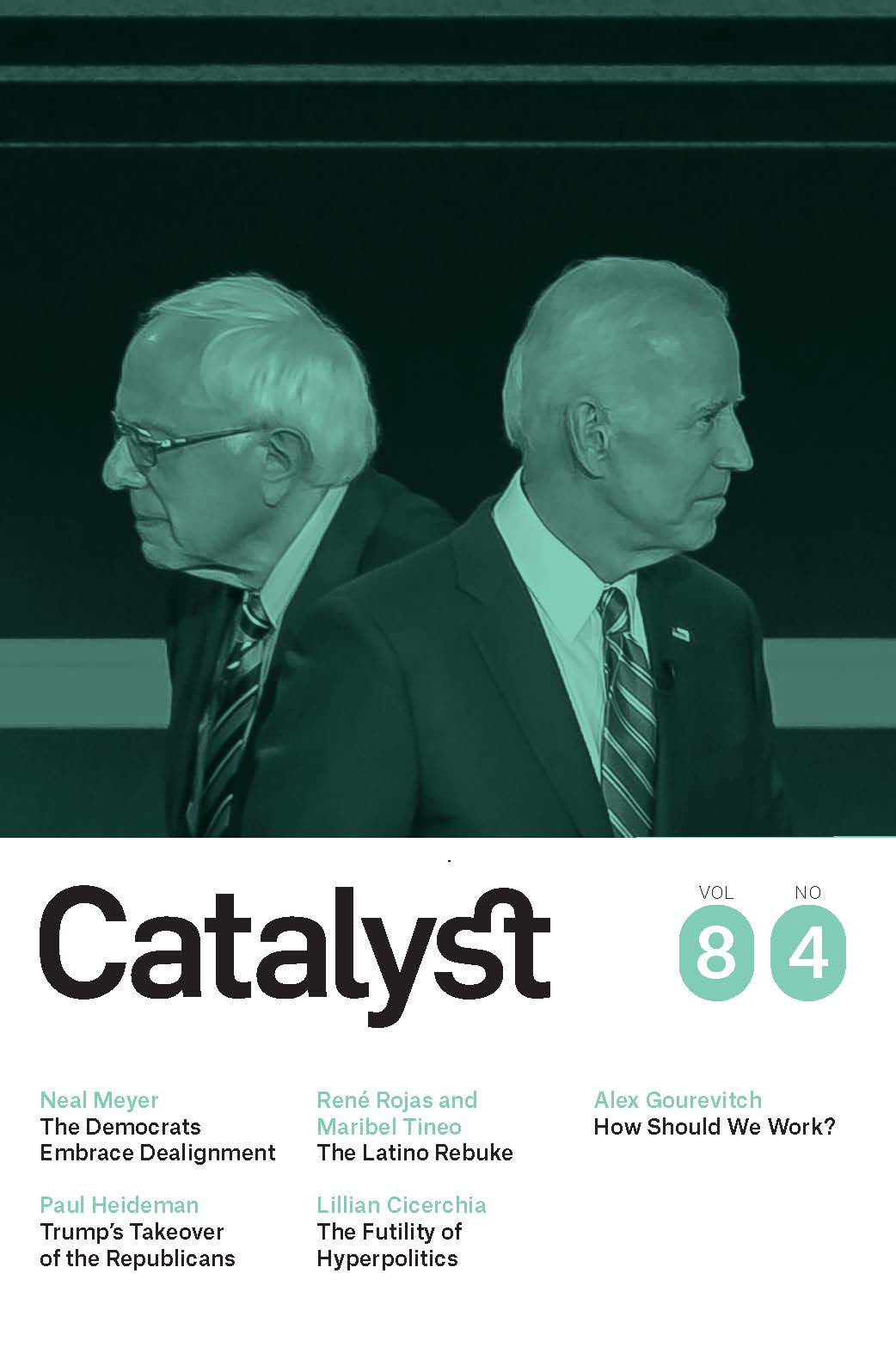
This issue of Catalyst focuses on the current political moment in the United States. There is every reason to believe that the second Donald Trump presidency is not going to be anything like the first. Not only is Trump himself better prepared; he has substantially added to his electoral base. Furthermore, he has secured significant political support from American business, not just from particular individuals but from what appears to be entire sectors. On the other side, Kamala Harris’s defeat has thrown the Democratic Party into its deepest crisis in decades. Hence, even as the Republicans rally around Trump, the Democrats appear to be rudderless.
Three of the articles in this issue focus on the 2024 US presidential contest. In the lead essay, Neal Meyer traces a dual process whereby the Democratic Party shed much of its working-class base and consolidated its policy agenda around a corporate outlook. It is sometimes suggested that the dealignment of the working class was a process outside the party’s control, and that the party had no choice but to adjust to an increasingly educated and suburban electoral base. As Meyer shows, however, the leadership of the party viewed the new electoral ecology as not a dilemma but an opportunity — and seized upon it to further accelerate its shift to the right. Harris’s crushing defeat was simply the denouement of this decades-long process.
Even while the Democrats tried to craft a new corporate coalition, the Republican Party and its corporate backers found themselves unable to stop the rise of Donald Trump. Paul Heideman analyzes the curious phenomenon of a party that has been the favored vehicle of American capital, now under the control of a president that business largely detested. Much as Meyer does in his article, Heideman traces this phenomenon to a decades-long process of business disorganization and an internal fracturing of the party.