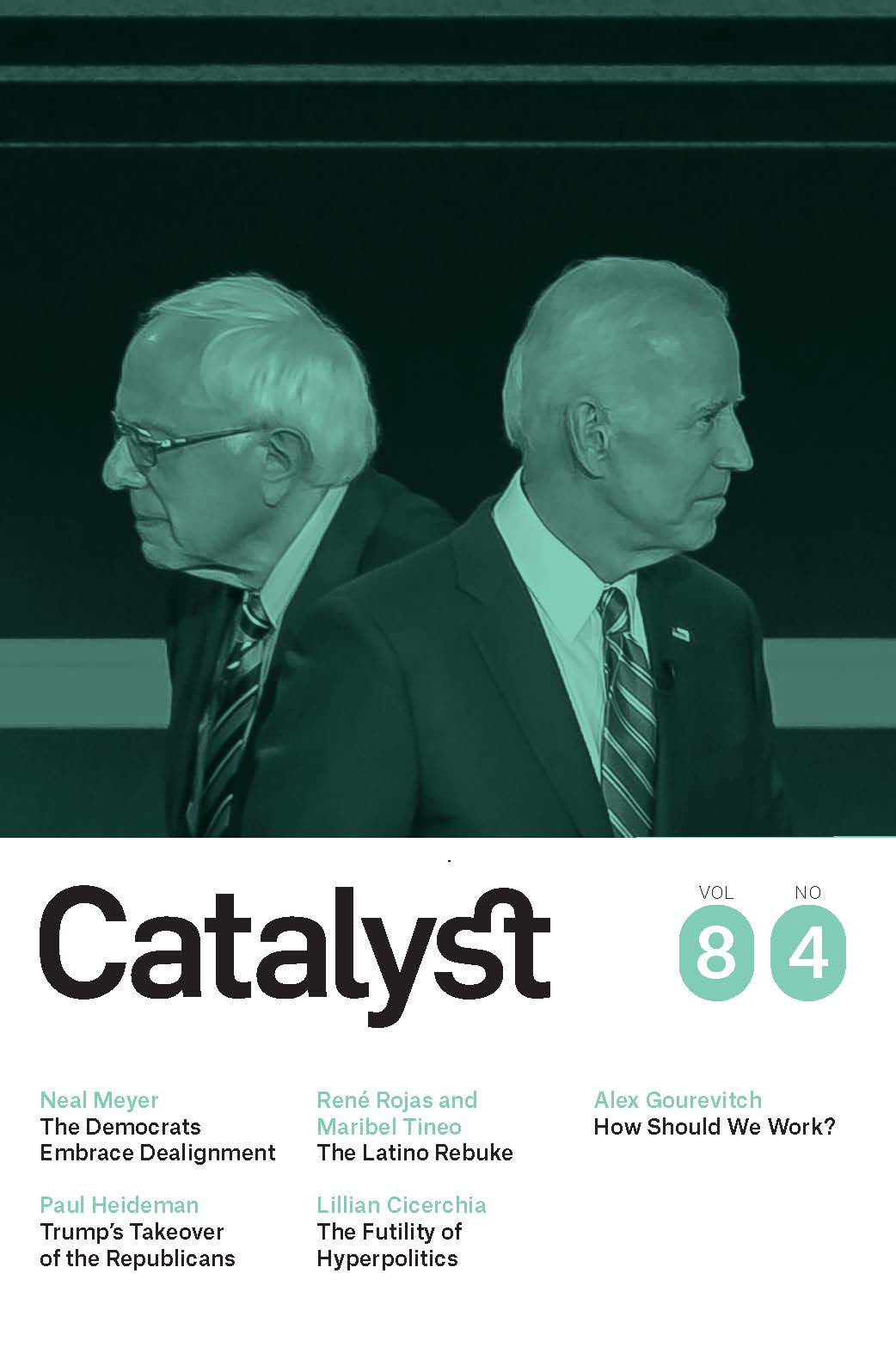
It used to be that people who commented on politics or were involved in them complained about political apathy and what to do about it. It was a constant challenge to make people care at all about public policy, elections, and foreign affairs. At the schools I attended, having strong political opinions marked one out as political (and probably liberal) in contrast to one’s peers. Today the political climate could not be more different. Politics is everywhere, all the time, and it feels like everything is political. What many are now calling “hyperpolitics” is a way of insisting on the politicization of every aspect of life.
This essay explores hyperpolitics, seeking to locate its social base and to reveal how that base pursues its interests in institutional settings while also generating an ideology that helps it navigate those settings. Hyperpolitics is not an empty exercise; it does not lack purpose or vehicles for advancing its view of political change. Its vehicles are just not useful to achieve meaningful gains for the vast majority of people. This essay offers a critique of hyperpolitics in addition to the socialist left’s relationship to it. What is needed, in the end, is a reorientation of the Left toward a different political vision and constituency.
What Is Hyperpolitics?
Hyperpolitics is our sense that everything is politicized. It is polarized political debate reaching into family dinners, sports leagues, streaming services, the Academy Awards, and the voting booth. It involves mass mobilizations, referenda, and partisan internet activism. The distinctiveness of this new form of politics is easiest to understand in a relational way rather than as a standalone description of political activism. As Anton Jäger writes, the hyperpolitics of the 2010s and 2020s is the historical successor to the post-politics of the 1990s and 2000s.1 It is worth drawing out three contrasts to explain this historical shift: emotional, cultural, and ideological.