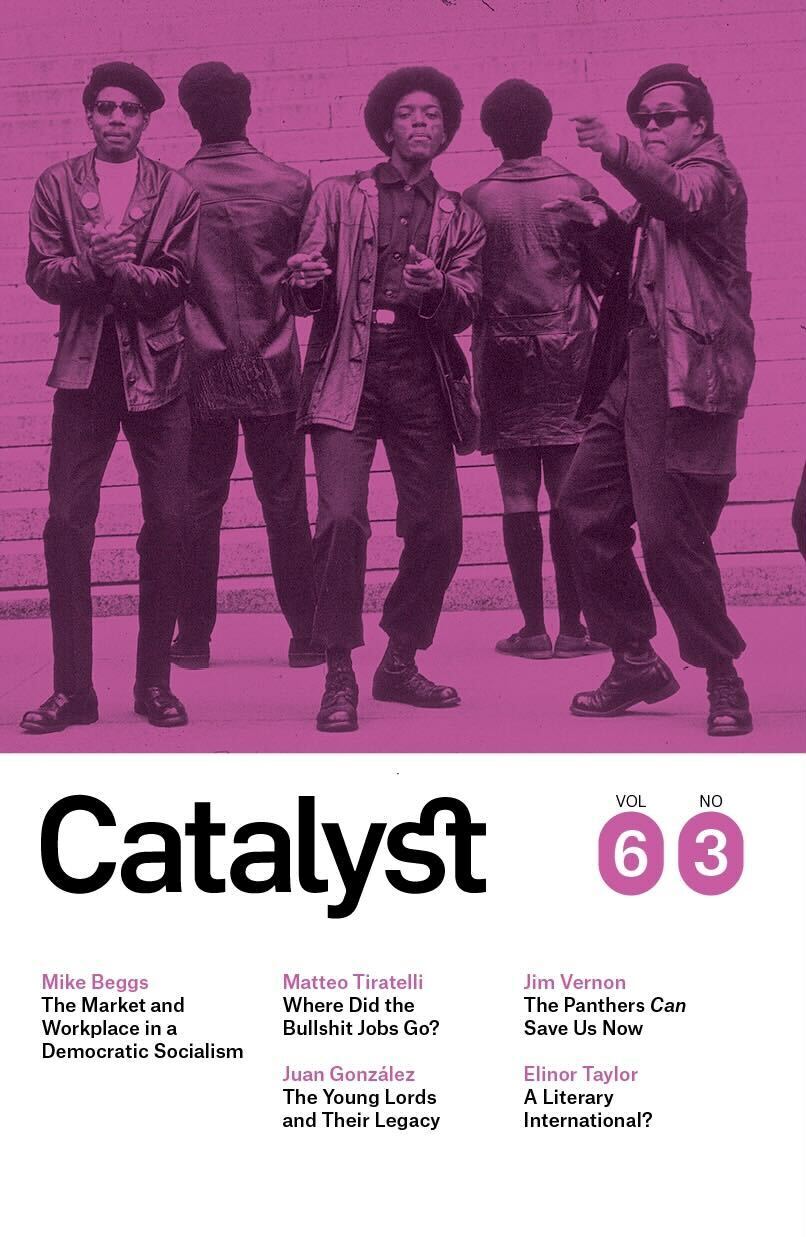
This issue of Catalyst opens with an important essay by Mike Beggs on market socialism. Over the past few years, Catalyst has published essays by Sam Gindin and by John Roemer on the subject, with each offering his own arguments for a viable socialism, albeit one in which markets play an important role. In his contribution, Beggs places the democratic firm at the core and shows that if it is to be the microeconomic foundation of market socialism, it calls for a specific constellation of institutional supports to generate the desired macroeconomic outcomes. Beggs brilliantly lays out the overall structure of such a system with a level of detail rarely encountered in the literature.
While Beggs focuses on the contours of a future economic system, the remaining essays examine the current one. In her review of Katerina Clark’s study of interwar Communist-inspired literature, Eurasia Without Borders: The Dream of a Leftist Literary Commons, 1919–1943, Elinor Taylor shows how the Third International, despite its limits and ideological rigidity, successfully promoted a rich body of work in the colonial world as well as the metropoles, all orbiting the subaltern struggles for a more humane order.
Then, in an interesting duo of complementary pieces, we present arguments assessing the strategic perspective of two of the most important anti-racist organizations of the New Left: the Black Panthers and the Young Lords. Jim Vernon interrogates Cedric Johnson’s depiction of the Panthers in his essay “The Panthers Can’t Save Us Now,” published in the inaugural issue of Catalyst, and his new book of the same name. Vernon very much agrees with Johnson that a genuinely anti-racist struggle must be founded on economic redistribution and universalist principles, against the narrow identity politics that is hegemonic today. And he also accepts that much of the Left today presents the Panthers as fellow travelers of a nationalist Black Power project that refused to admit the internal stratification in the black population. But contra Johnson, he suggests that the Panthers were in fact advocates of the very multiracial class-based strategy that Johnson recommends, and hence, far from being precursors to today’s identitarian politics, they belong in the pantheon of socialist liberation struggles. Complementing Vernon’s essay on the Panthers, journalist and organizer Juan González looks back on his experience with the Young Lords, one of the most important organizations of the Latino struggle in the 1970s. González sees the Lords as inspired by the same class-oriented ambitions as the Panthers but, in the end, as succumbing to many of the same organizational and tactical weaknesses of the latter. Just as debilitating, González insists, was the slow capture of the Latino struggle by an emerging class of professionals and politicos, who transformed it from a broad campaign for emancipation to a narrow instrument for elite Latino advancement.