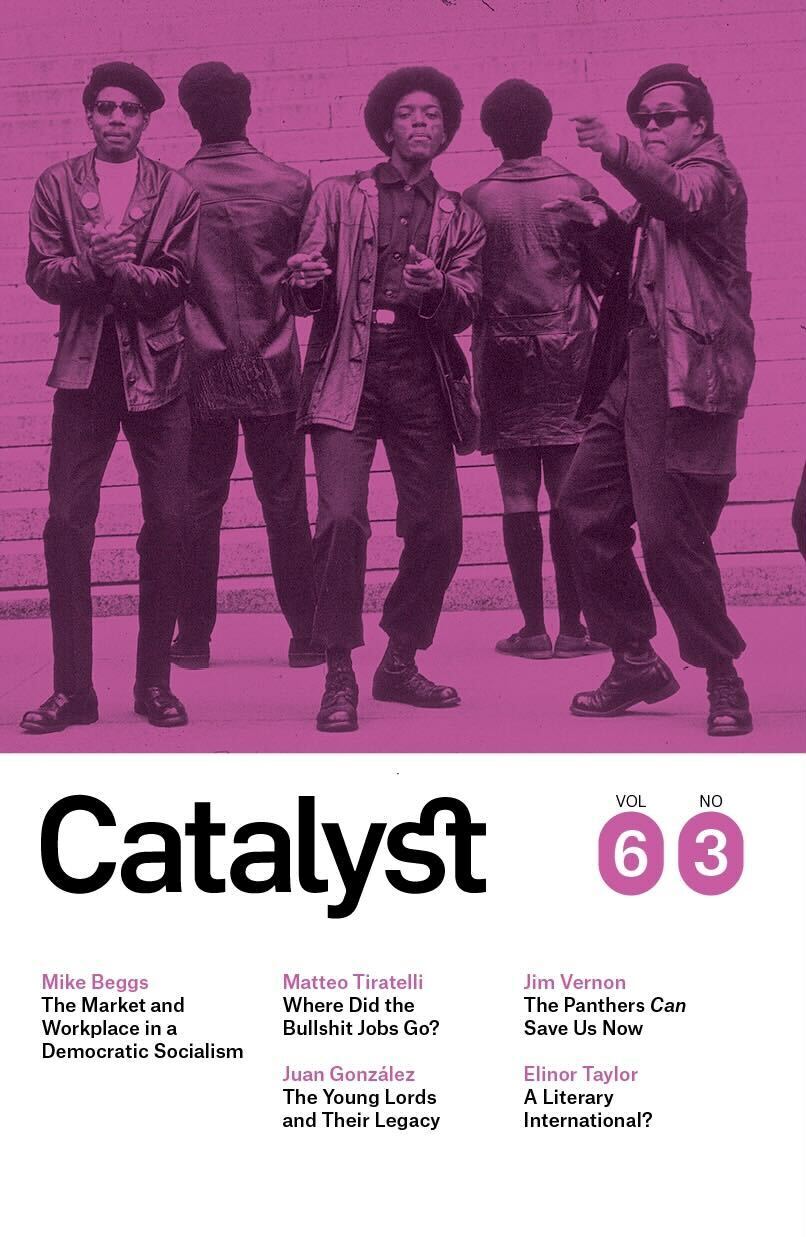
Few recent scholarly interventions have immediately received a more impassioned response than Cedric Johnson’s 2017 article “The Panthers Can’t Save Us Now.”1 With some of the earliest substantial contributions now helpfully gathered into a collection bearing the same title, the debate surrounding it will assuredly grow exponentially.2 The central theses of the piece are now both well known and relatively easy to sketch. Against the prevailing identitarian tide vaguely marching under the banner of Black Lives Matter (BLM), Johnson “takes aim at [the] notion of black exceptionalism,” which posits the existence of a generally homogenous “‘black community,’ all of which suffers the indignities and liabilities of racial subordination.”3 As a result of their common experience of racial oppression, the members of this “community” are assumed to “possess territorial ways of knowing the world and, by extension, deeply shared political interests” that radically distinguish them from others as a group.4 Blackness, in other words, is a not just a real and specifiable identity but a political one, and the black community is correlatively defined by political problems, aspirations, and perhaps even strategies that are radically unique to black life, and thus by definition not shared with others. In essence, Johnson argues, black exceptionalism “falsely equates racial identity with political constituency,” for it either unconsciously elides or intentionally conceals the “cultural and class diversity of Black America,” erasing the vital differences between the needs, interests, aims, and political positions internal to any sufficiently large group in a stratified society.5 Black exceptionalism, which “wrongly views blacks as ‘a people without classes or differing class interests,’” is perfectly suited to bolster and impose a form of brokerage politics wherein individual members of an internally diverse and even contestatory population are transformed into its authentic representatives — regardless of their distance from the problems, regions, and constituencies at issue, their differing grasp of the most vital problems faced by said communities as well as the most viable or supported solutions to them, and even their own role in entrenching the very structures in need of the deepest transformation.6 Thus, when “we examine the social composition of left currents, which are largely the same as those articulating the rhetoric of Black [exceptionalism] today,” we find primarily “academics, nonprofits, political operators, and a thin layer of professionals” — in other words, cultural elites “largely unmoored from the working class.”7
Put bluntly, Johnson argues that black exceptionalism, as well as the contemporary “anti-racist” activism grounded in it, not only undermines organized, truly grassroots struggles for substantive structural change but deflects from a critical focus on the economic engine of insecurity and inequality, replacing it with a focus on issues of special concern to the black (and white) liberal elite: increased representation on corporate and other institutional boards, mandatory DEI (diversity, equity, and inclusion) training in educational and governmental bodies, the identification and reduction of microaggressions, and other “progressive” changes the owning class is all too happy to incorporate into its language and practice to appear consonant with trends in “social justice.” As he puts it, “corporate anti-racism is the perfect egress from . . . labor conflicts. Black Lives Matter to the front office, as long as they don’t demand a living wage . . . and quality health care.”8 This, Johnson argues, explains why — as his earlier monograph Revolutionaries to Race Leaders demonstrates with exacting detail — black exceptionalism was and still is “encouraged by liberal statecraft from above”; it facilitates and entrenches “a form of ventriloquism that has long been a problem within black political life and scholarly and popular interpretations thereof,” creates a disciplinary managerial and academic caste whose “egalitarian” demands subvert the difficult but demonstrably achievable forms of cross-racial solidarity necessary to force deep-rooted structural change, and redirects popular struggle into largely superfluous battles, even if there are occasional victories therein. Against this trend, Johnson issues a full-throated call to “make common cause with the millions of over-policed Americans who do not fit into a Black Lives Matter framework” in order to “grow beyond street demonstrations to build popular consensus and effective power.”9
I should make clear from the outset my complete and enthusiastic agreement with Johnson’s central argument. In both The Panthers Can’t Save Us Now and his previous work, he has, in my view, convincingly demonstrated not only the conceptual and strategic limits of the ideology of Black Power but the need to find a way to recenter economic analysis and universalist solutions in contemporary leftist struggle. However, given the book’s emphasis on BLM, corporate anti-racism, and an academically tinged ethnic politics, as well as Johnson’s virtually unparalleled knowledge of the historical context from which they emerged, I find it perplexing that not only the original essay but the expanded volume uses the Black Panther Party (BPP) as a key exemplar of black exceptionalism. This decision is especially curious because — much like in his magisterial monograph on the historical evolution of Black Power — the BPP features only marginally in both the titular essay and the other contributions. Why give the original article and even the subsequent and expanded book a title that focuses on an organization barely mentioned in either?