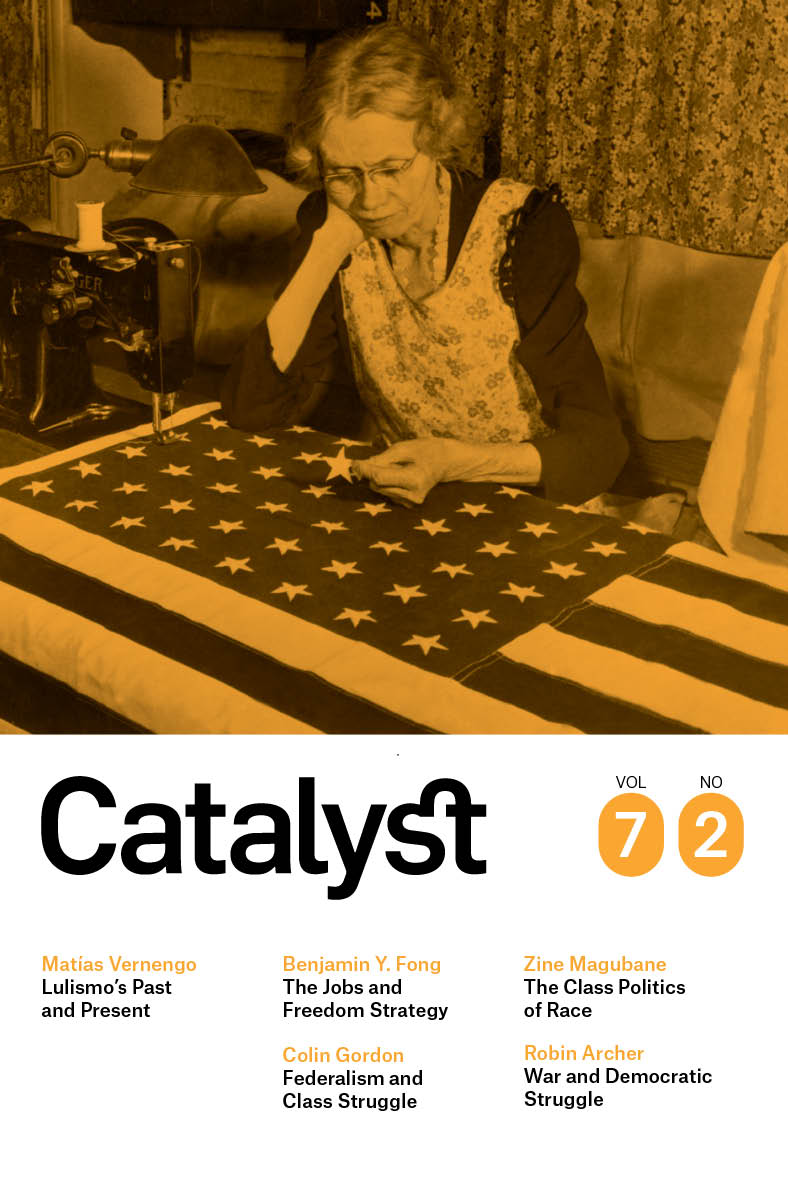
This issue of Catalyst takes up the central problem of left strategy, north and south. The reelection of Luiz Inácio Lula da Silva to the Brazilian presidency earlier this year has been cause for much celebration. But as Matías Vernengo points out, there are worrying signs that Lula might adopt an unduly restrictive economic policy, which is not only dubious on technical grounds but also likely to further erode his political base. Vernengo provides a bracing analysis of the Brazilian political economy, as well as a set of recommendations for a workable and progressive economic strategy.
Turning to the United States, Benjamon Fong, Zine Magubane, and Colin Gordon examine the prospects for breaking out of the current political moment. Fong makes a case for excavating and committing to the strategy for racial justice formulated by Bayard Rustin and A. Philip Randolph in the civil rights era. Embodied in the Freedom Budget, this strategy sought to embed the civil rights movement in a broader social democratic and universalistic call for redistribution. Fong revisits the conjuncture when Rustin and Randolph proposed the Freedom Budget and argues that, even though the two movement leaders failed to advance the agenda then, it still provides the best template for a race politics today.
Fong’s argument is amplified by Zine Magubane in her review of Kenan Malik’s book Not So Black and White. Magubane praises Malik for his powerful critique of race identity politics and his advocacy for a more universalistic, redistributive agenda, much in the spirit of Randolph and Rustin’s vision. And she very effectively relates his argument to the putative debate between the 1619 and 1776 projects in the United States, showing that, despite much heat and light, both projects evince a fidelity to elite interests, precisely because they refuse to go beyond “black and white.”