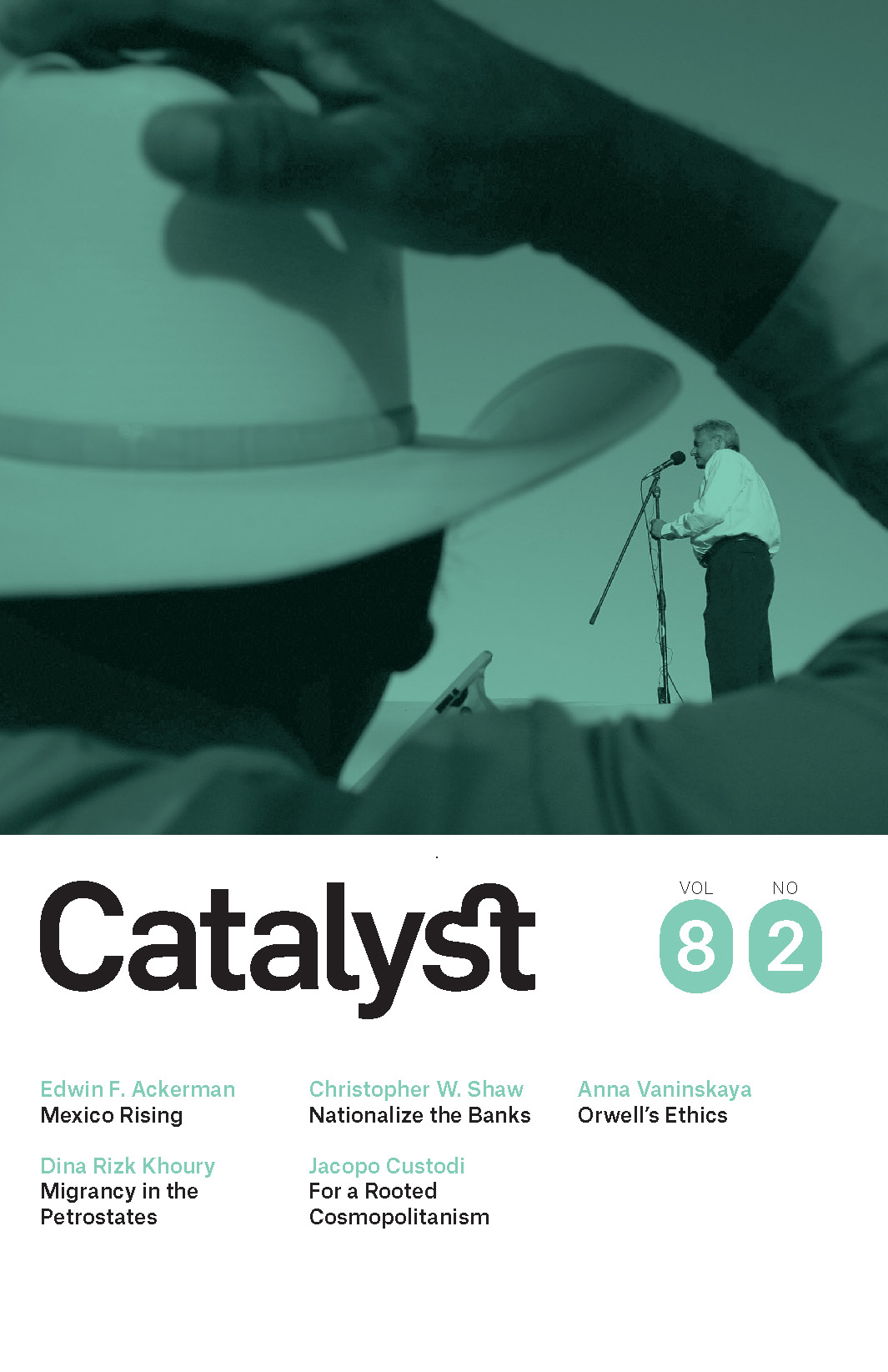
The recent elections in Mexico are a tremendous development in continental politics. The election of Claudia Sheinbaum as president represents not just a continuation of Andrés Manuel López Obrador’s progressive agenda but the potential for lasting change in the country’s political economy. As Edwin Ackerman’s article makes clear, Sheinbaum’s victory was engineered through her articulation of a political agenda around the material interests of the laboring classes, which in turn stemmed from a deep engagement with their daily lives. In many ways it is an object lesson in how a progressive, class-oriented politics can win the confidence of the very groups that have given up on politics around the world. Here in the United States, we now find some faint echoes of such possibilities among the newly empowered progressive Democrats, but there are plenty of historical legacies to draw upon. Christopher Shaw lays out in his essay the long history of support for socializing the banks, which must be a pillar of any social democratic advance. As Shaw makes clear, popular revulsion for the titans of finance has been a steady theme in American culture since the late nineteenth century, and that feeling could be revived again.
An additional theme raised by Sheinbaum’s victory in Mexico is the importance of articulating a left agenda in language and symbols that are rooted in national culture. Socialists have always been understandably skeptical of flag-waving appeals to patriotism. But eschewing jingoistic nationalism is perfectly consistent with embracing a popular politics anchored in local culture. Jacopo Custodi makes a persuasive case that the Left cannot connect with the popular classes unless it also affirms their pride in their cultures. This is one thing that makes organizing in settings like the Gulf states particularly difficult. For as Dina Rizk Khoury shows in her article, the working class in those states is preponderantly migrant and therefore of culturally and socially diverse origins. This heaps an additional layer of heterogeneity on top of the existing differences and tensions in any working class. Khoury presents a sobering description of the conditions of work and political organizing in those states, a landscape that is among the most daunting in global capitalism.
Finally, in Anna Vaninskaya’s review of Peter Brian Barry’s George Orwell: The Ethics of Equality, we see that the challenge to articulate the principles of a liberal and egalitarian politics was one that Orwell understood as well as any twentieth-century intellectual. His thought presents a particular challenge because, unlike the academic philosophers who comprise Barry’s intended audience, it is primarily concerned with connecting to ordinary readers and not so much with articulating its principles in a formal and enumerated fashion. Orwell’s work continues to present rich avenues for the Left today to deepen and develop their own moral principles, regardless of the material effects of his ethical thought in his own time.