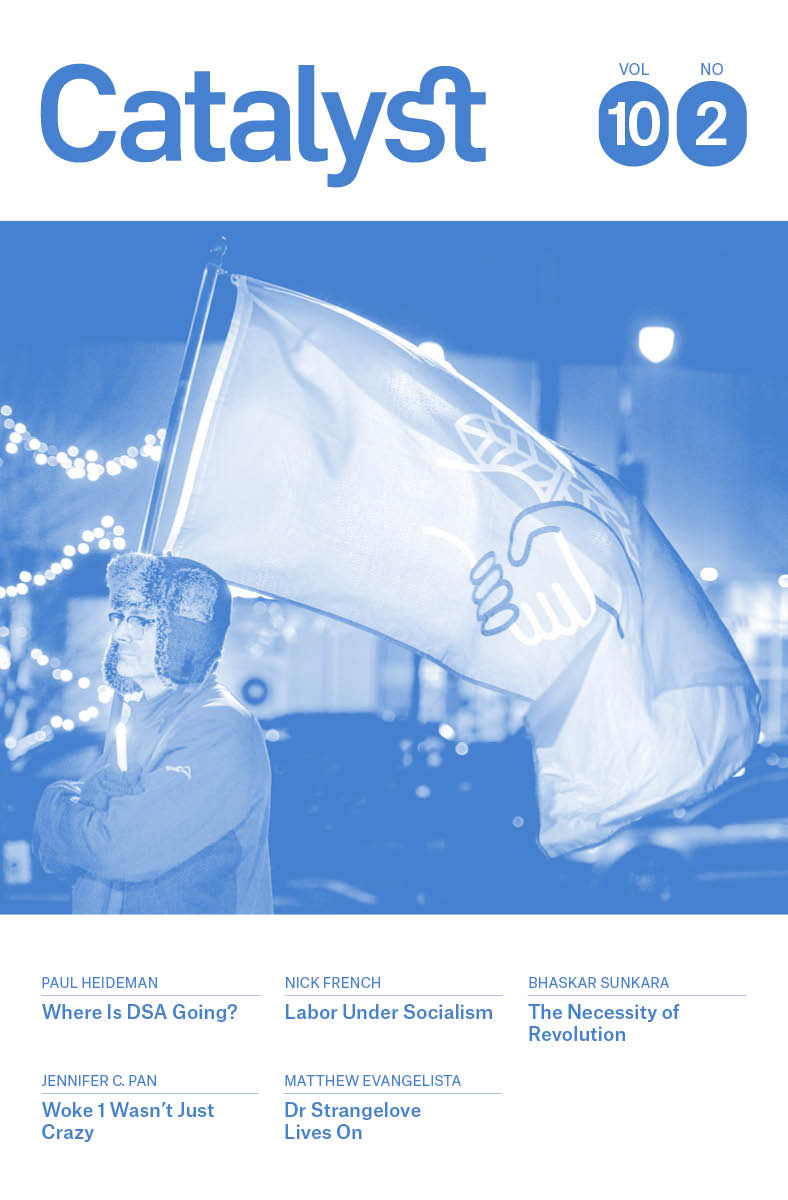
This issue is dominated by strategic and ideological challenges for the Left. In the lead article, Paul Heideman takes up one of the most important political developments of our time: the explosive growth of the Democratic Socialists of America (DSA). An organization that had something around six thousand members in 2016 has ballooned to more than one hundred thousand in a mere ten years. This makes it one of the largest left organizations in American history, if not the largest. It has already had a palpable effect on the country’s electoral politics, and it can boast a stable of the most dynamic and inspiring public officials in the country. As it has grown in size and influence, it has been much admired, but it remains inadequately studied.
Heideman offers a historical overview of the group as well an assessment of its political culture. As he observes, it is in many ways a tale of two cities. There are DSA branches that are thriving and managing to connect to working-class interests, taking the first steps toward building a durable mass base. But then there are many branches that cling to performative politics and are content to languish in marginal subcultures. Both tendencies are prominent in the organization, and which one will win out is yet to be determined.
In a sharp and bracing complement to Heideman’s piece, Jennifer Pan offers a critique of the destructive embrace of diversity, equity, and inclusion (DEI) initiatives and the broader phenomenon of “wokeness” within the liberal left. As she points out, not only is the phenomenon reviled by much of the working class; initiatives that could garner significant support are often wrongly branded in language that will actively repel working people from anti-racist initiatives. Both directly and indirectly, Pan observes that, until the socialist left ditches once and for all the counterproductive and elitist political culture swirling around DEI, it will never build a base within the working class.
Nick French, in his essay, tackles the normative issues involved in the current visions of socialism. Recent years have witnessed a revival of market socialism as a preferred vision of postcapitalist society. But what exactly will the institutions of market socialism look like? In particular, how might we handle the allocation of labor? There are two broad approaches for the deployment of labor in a socialist economy. One is to assign it authoritatively, the same as any other commodity would be allocated in central planning. People would be directed by central planners to take up particular jobs. French makes the case that it is preferable, on moral and on pragmatic grounds, to rely on a labor market, where workers make decisions on their own, based on their economic and social preferences, rather than being told what to do by a central authority.
We also publish a presentation by Catalyst publisher Bhaskar Sunkara on the road to socialism. Sunkara forcefully argues that there may not be an aggregative, incremental road to socialism at all. While electoral initiatives and legislative reforms are the best instruments for building a durable socialist movement in the short run, they should not exhaust our strategic repertoire. At some point, there has to be a break with capitalism, embodying a qualitative leap out of the present system and into the new one. In other words, there must be incremental changes in the short term and a ruptural break at some point in the long run.
Of course, for this to be a viable strategy at all, there has to be a longer run. And one of the greatest threats to a longer time horizon is the revival of a global nuclear arms race. The return of this madness under the Joe Biden and Donald Trump regimes behooves us to revisit the experience of nuclear arms during the Cold War era. Few scholars are better positioned for that than historian David Holloway, who brings together a lifetime of research and analysis in his book Nuclear Weapons: An International History. In his essay-length review of Holloway’s book, Matthew Evangelista, also a leading scholar of the Cold War, argues that the entire rationale behind nuclear proliferation lacks warrant. Holloway seems to think that the experience of the Cold War shows the possibility of successful deterrence. But as Evangelista notes, Holloway’s own evidence shows that blind luck played a big role in averting nuclear catastrophe. And luck is not a strategy. Indeed, what the record shows is that at key moments, had things gone a little differently, a nuclear holocaust was not only possible but very much on the agenda. The only way out is to rekindle the spirit of the peace initiatives of the postwar decades and to eradicate nuclear weapons once and for all.