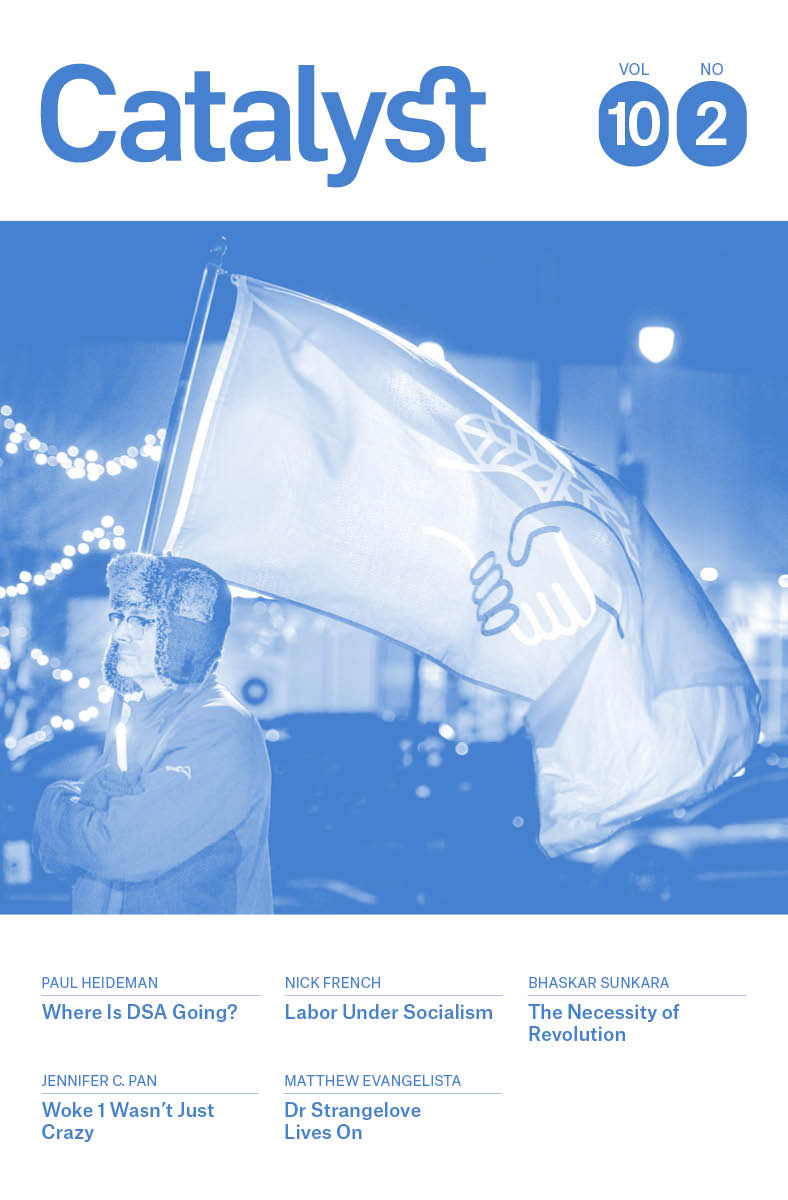
(Spencer Platt / Getty Images)

Vol 10No 2Summer

Where Is DSA Going?

The history of the American left is marked by imposing peaks and valleys. Over the last century and a half, organizations have sprung up and, often within a decade of their founding, become major institutions of US politics. They have typically declined nearly as quickly, with few sustaining their positions in American society longer than a decade or so. The Populist Party emerged in the early 1890s, won nearly 10 percent of the vote in the 1892 presidential election, and had largely disappeared by 1900. The Communist Party, founded in 1919, reached about seventy-five thousand members in the mid-1940s, only to collapse, through repression and its own mistakes, to under ten thousand by the end of the 1950s. The trajectories of the Knights of Labor, the Socialist Party, and Students for a Democratic Society, despite their different structures and purposes, are all strikingly similar.1

In the last decade, the Democratic Socialists of America (DSA) has formed a new peak in this landscape. Growing rapidly since 2016, the group jumped from about 6,500 members in 2014 (with a median age of sixty-eight) to over one hundred thousand members (with a median age of about thirty-three) in 2026.2 At the same time, the group has elected hundreds of members and endorsed candidates to offices from county boards to US Congress. In its size and impact, it now sits with the most significant institutions of the American left.

What accounts for this ascent, and what does it portend? Answering these questions requires resisting two temptations that have shaped much of the commentary on DSA. The first is triumphalism, the assumption that the organization’s growth is the leading edge of an irreversible socialist revival and that its trajectory can only continue upward. The second is the mirror image of this, a declinism that reads each of the group’s many internal crises as the beginning of the end. Both err in the same way: they mistake the story of a single organization for that of a whole political conjuncture. DSA’s rise cannot be understood apart from the institutional structure of American electoral politics, the specific sequence of events that revived the American left after 2008, and the strategic choices the organization has made in response to both. Its future will be determined by the same forces.
This article will place DSA in the context of the electoral projects of the American left and assess both its achievements and its limitations. It begins by arguing that the institutional transformation of US elections over the twentieth century — above all, the introduction of the direct primary and the proliferation of ballot access restrictions — has made third-party politics a dead end and has channeled left electoral energy into the Democratic Party. This structural fact, more than any strategic error or ideological failing, explains the shape DSA has taken. The article then traces the organization’s revival through the two Bernie Sanders presidential campaigns, which transformed a stagnant remnant of the old socialist movement into the largest left organization in the United States in generations. From there, it turns to the strategic debates that have convulsed the group since 2016, the remarkable string of electoral victories its chapters have won, and the internal crises — over centralization, over the Democratic Party, and over Palestine — that have accompanied its growth. It closes by weighing the organization’s most serious limitations: the enormous variation in political culture across its chapters, its isolation from large sections of the working class, and its difficulty establishing a presence outside the electoral arena. These are not incidental weaknesses but structural ones, and whether DSA can overcome them will determine whether it becomes a lasting force in American politics or simply the highest peak yet in a landscape defined by valleys.

The Limited Relevance of Pre–World War II Left Political Projects

Discussions of DSA’s strategy are rife with comparisons to other leftist electoral projects. The Socialist Party of Eugene Debs’s era in particular forms a key point of comparison for writers from various political positions.3 Yet what often goes unexamined in these comparisons is the profound institutional transformation of electoral politics that separates the Debsian Socialist Party as well as efforts that predate it, such as the People’s Party (more commonly known as the Populists), from DSA. The introduction of primary elections and the spread of ballot access restrictions have drastically changed the strategic calculus for electoral politics and ensured the abject failure of third-party efforts since their introduction.

It may be objected that discussing these twentieth-century institutional changes is unnecessary, as the adamantine nature of the two-party system in the United States can be explained as a simple consequence of Duverger’s law. Named after the political scientist Maurice Duverger, the rule states that in a winner-take-all, first-past-the-post electoral system, such as exists in the United States, a two-party system will result. This is because the system places third parties in the inevitable role of spoilers, where voting for them only makes more likely the election of one’s least-favored alternative. But Duverger’s law is insufficient to explain two-party dominance in the United States, either historically or comparatively. Historically, third parties, particularly in the late nineteenth century, had considerable success, electing nearly sixty representatives, five senators, and more than a dozen governors. From a comparative perspective, two-party dominance is far more pronounced in the United States than in the United Kingdom, Canada, or India. Something else is at work.4

One piece of the puzzle is the introduction of the direct primary in the early twentieth century. Prior to the direct primary, candidate nomination was managed through some combination of party nominating conventions and simple diktat by party leaders. Direct primaries, by contrast, involve holding an election among some class of voters: either voters signed up with the party, which is called a closed primary, or any voter who chooses to vote in the primary, which is called an open primary. These elections are typically administered by the state rather than the party. During the Progressive Era, when politics in most states were dominated by a single party, challengers, who had no hope of ousting incumbents on the opposing party ticket, turned instead to attacking the power of parties themselves. The direct primary, by expropriating parties’ control over their ballot lines, was one of the chief lines of attack.5

Primaries drastically change the incentives for those who wish to challenge the policies of a political party. Rather than building an entirely new party apparatus, they make it possible to challenge an incumbent party leadership in a lower-turnout election that requires mobilizing far fewer voters. Once a primary is won, the challenger simply inherits large portions of the existing machinery of the party. In parts of the country that are dominated by one party, winning a primary effectively guarantees victory in the general election. As such, the political entrepreneurs who hope to challenge an incumbent party leadership, and the voters dissatisfied with that leadership, tend to run and vote in primaries rather than building a third party.6

The incentive to compete within existing parties is heightened by the legal hurdles to such endeavors that have been thrown up since the early 1900s. Chief among these are ballot access laws, mandating a certain number of signatures be collected by third parties who wish to appear on the ballot. The Democrats and Republicans are often exempted from such requirements, creating one set of laws for the two major parties and another for everyone else. These laws began proliferating as states attempted to repress the Communist Party in the 1930s but have been used frequently since then, as major parties fear third-party competition.7

Combined with primaries, ballot access laws further disincentivize challenging parties from without. They create uncertainty about whether it is even possible to appear on the ballot and ensure challengers need to spend their limited resources on gathering signatures and navigating the inevitable legal challenges the two major parties mount regarding the signatures.8

Primaries open the door to challenging the party from the inside, and ballot access laws close the door to challenging it from the outside.9 Given this combination, it is little surprise that the postwar period has never seen a sustained third-party challenge reach the level of the Debsian Socialist Party, let alone that of the People’s Party. Instead DSA, as the most successful US socialist project of the post–World War II era, has grown primarily by organizing itself as a force within the Democratic Party.

The Sanders Campaigns and the Rebirth of DSA

DSA’s origins go back to the 1970s. It was founded out of a fracture in the Socialist Party, which by the 1960s had dwindled to a group with some influence among unions and intellectuals but little mass base. Much of the group recoiled in horror at the development of the New Left, seeing them as spoiled middle-class children embracing Stalinist totalitarianism. In 1972, the group split. The majority embraced hawkish Cold War anti-communism, while a minority led by Michael Harrington, who had achieved fame as a socialist writer and speaker, founded the Democratic Socialist Organizing Committee (DSOC).10 Leveraging close ties with some of the more progressive union leaderships, the organization achieved some real success in the late 1970s by cohering a socialist pole within the Democratic Party.11

In the early 1980s, the group merged with the New American Movement, veterans of the New Left who had reached similar political conclusions to DSOCmembers. This merger created DSA. Though the new group was larger than DSOC, the political environment of the 1980s proved inhospitable to socialist politics, and membership remained largely stagnant over subsequent decades.

The American left experienced some rejuvenation following the turn of the century, and this set the stage for DSA’s rebirth. First, the movement against the Iraq War was a crucial politicizing context for many in the cohort that would emerge as DSA’s new leadership. Second, the financial crisis of 2008 and the glacial recovery that followed gave a new prominence to economic inequality in US politics. Finally, the Occupy Wall Street movement showed that mobilizing large numbers of people around this issue was possible.

Bernie Sanders’s 2016 primary campaign transformed this growing radicalization into a force that would reshape both DSA and US politics as a whole. In his first presidential campaign, Sanders won over thirteen million votes in the state primaries, and his steadfast advocacy for democratic socialism throughout the campaign helped to coalesce a new left pole in American politics. The organizational expression of this was the rebirth of DSA.

Organizers in the group were quick to recognize the potential of a Sanders campaign. DSA had supported Sanders earlier, including in his campaign for the Senate in 2006, raising about $60,000 (or 1 percent of his fundraising) for him.12 Sanders himself declared his interest in running for president in an interview with The Nation at the beginning of March 2014. Within weeks, DSA members were discussing a petition campaign encouraging him to run and laying the basis for DSA’s participation in his campaign.13 By the beginning of April, they had launched their petition.14

Over the course of the campaign, DSA members participated at all levels. Local chapters organized tablings and social events (“Beers for Bernie”), and members played a central role in the Labor for Bernie group that worked to recruit union members to the campaign.15 Much of this was organized through the group We Need Bernie, which DSA members formed as an independent expenditure group to support Sanders’s run. Even at the Democratic National Convention in the summer of 2016, where Sanders’s defeat by Hillary Clinton was officially pronounced, DSA members organized a Socialist Caucus at the DNC, bringing the fifty-five DSA members who had been elected delegates together with other Sanders delegates.16

DSA’s energetic participation in the campaign dovetailed with other dynamics to supercharge the group’s growth. Sanders was emphatic about identifying as a democratic socialist, and DSA had the phrase in its name. It also, unlike most other existing socialist groups, had basically no barrier to entry, requiring no political education to become a member. As a result of all this, by mid-2017, the group’s membership had roughly tripled to twenty-five thousand, turning it from a group consisting largely of retirees to the biggest socialist organization in the United States.17

When Sanders began gearing up for his 2020 campaign, DSA was well-prepared to support him again. Already in October 2018, the DSA National Political Committee (NPC, the group’s elected leadership body) had convened an exploratory committee to discuss possible orientations toward the 2020 primaries, with an eye to preparing for a Sanders run. This committee proposed a process for endorsing Sanders in which the NPC would run a membership poll immediately after he announced his candidacy, and if the membership voted to endorse, the NPC would then issue an endorsement and begin organizing a campaign.18 This is precisely what happened in March 2019. Of the 24 percent of members who voted, 76 percent voted to endorse.19 Two days after Sanders officially announced his campaign, the NPC had endorsed him.20 At this point, DSA’s membership had grown to about fifty thousand members.21 As a result of the organization’s growth since 2016, it was able to play a much larger role in the 2020 campaign. In cities where the Sanders campaign did not have a field office, like Chattanooga, Tennessee, and New Orleans, Louisiana, DSA was effectively the local campaign, organizing canvassing and phone banking.22 Overall, the DSA for Bernie campaign knocked on over half a million doors in the race.23

Despite all of this, Sanders’s defeat came quickly. After he won the first three primary contests, most of the Democratic candidates dropped out and endorsed Joe Biden, who seemed to be the only one who could plausibly stop Sanders. After running an unimpressive showing in the first three states, Biden won a decisive majority of delegates from the Super Tuesday primaries, and Sanders never recovered.

Despite the gut punch that Sanders’s defeat represented, DSA grew considerably throughout the campaign. By March 2021, it had reached ninety-one thousand members, bringing it close to the Socialist Party’s peak over a century earlier. What historian Matt Karp has called “Bernie Sanders’s Five-Year War” transformed DSA from a stagnating group of aging leftists to the primary organization of a new generation of the American left.24 The process was not without growing pains.

Strategic Debates

DSA was transformed by the Sanders campaigns. As Meagan Day and Micah Uetricht wrote, DSA had become “a different entity than the one that existed two years prior.”25 Previously DSA had been a relatively politically homogeneous group, with broad agreement on the political approach Harrington had articulated in the 1970s and ’80s. By 2017, DSA contained within it nearly every tendency of any significance on the US left, from Trotskyists and Marxist-Leninists to anarchists. These tendencies were at first mostly unorganized, but DSA quickly developed a vigorous culture of internal factionalism, carried out largely through different caucuses. The group’s evolution since 2016 is, in part, the evolution of the political debates within it, which have focused on questions ranging from the group’s internal organization to its relationship to elected officials.

Two essays have been touchstones for many of the discussions within DSA and are worth briefly reviewing before getting into the specifics of factional debates. The first is Seth Ackerman’s piece from late 2016 entitled “A Blueprint for a New Party.” Ackerman argues that aspects of American election law, such as those described earlier in this essay, foreclose third-party politics as a route for building an electorally competitive left. Instead leftists need to construct a kind of party within a party: an organization that uses the ballot line of one of the major parties but has its own program, membership, organizational structure, and fundraising apparatus. Though Ackerman himself does not use the phrase, this proposal has come to be commonly referred to as the party surrogate model and has been referenced widely in debates in DSA.26

The other article is Eric Blanc’s “The Ballot and the Break,” from late 2017.27 Blanc’s article is a history of the Minnesota Farmer-
Labor Party (FLP), which was built in the 1920s and became, for a time, a successful state-level labor party, independent of the Republicans and the Democrats. Blanc argues that the FLP was established along the lines that Ackerman suggested: by building up independent organization in Minnesota’s politically dominant Republican Party. But the crucial moment in the process came when FLP supporters left the GOP and established their own party. Blanc calls this strategy the “dirty break,” contrasting it with the demand from many socialist groups for a “clean break” with the Democratic Party. Rather than embark on the mission of forming a third party immediately, Blanc argues, socialists should follow the FLP’s example and use the Democratic ballot line to build up their forces until they are strong enough to launch a credible electoral vehicle of their own.

It would take time for these to become orienting points in the debate. At the first DSA National Convention held after the 2016 Bernie campaign, in August 2017, factionalism in the organization remained muted, and the positions that would divide the organization were just beginning to take shape. In the months leading up to the convention, two main groupings appeared. First, the Momentum slate of NPC candidates argued for unified national priorities, most centrally a campaign for Medicare for All, and for an electoral approach that largely followed the strategy suggested by Ackerman. The group also embraced several proposals that would break with past practices, most notably endorsing the Boycott, Divestment, and Sanctions (BDS) campaign against Israel and disaffiliating DSA from the Socialist International.28 A second grouping, calling itself Praxis, also coalesced. Praxis rejected Momentum’s focus on nationwide priorities, preferring to let local chapters set their own courses, and pushed for NGO-style skills trainings as a means to democratize the organization, by which they meant giving members the skills to do their own organizing without relying on official DSA structures.29

The convention delegates ultimately elected six NPC candidates from Momentum, five from Praxis, and five from DSA’s pre-2016 membership. It also voted for endorsing BDS and leaving the Second International. Proposals to commit DSA to a more hostile posture toward the Democratic Party failed but received about 40 percent of the vote, portending the organization’s leftward shift over these questions.30

After the convention, the factional ecosystem grew even more dense. At the convention itself, the Libertarian Socialist Caucus was formed, consolidating an explicitly anarchist current in DSA. A few months later, DSA Refoundation was launched as an explicitly “revolutionary socialist” caucus, which largely consisted of members from various Trotskyist currents. Many supporters of Praxis, meanwhile, reformed as a caucus simply called Build, reflecting a mostly nonideological approach that continued Praxis’s emphasis on decentralization. The Momentum slate launched the Spring Caucus, which soon split over internal disagreements, resulting in the formation of Bread & Roses, which generally continued the commitments that had defined Momentum. Some of these currents, like DSA Refoundation, would dissolve in internal acrimony before the next convention.31 More generally, this was a period of real instability in the new organization, with some NPC members resigning and leaving the organization. Despite this, local chapters achieved a great deal in their organizing and successfully laid the foundations for DSA’s intervention in the 2020 Sanders campaign.32

Yet the success of many DSA chapters reinforced a de facto decentralization that only intensified after the 2017 convention. Though the Momentum slate, which had been the strongest advocate of centralization, won the most seats on the NPC, over the next two years, the NPC was largely consumed with internal crises of various sorts and, as a consequence, failed to provide national political leadership to the organization. Immediately after the 2017 convention, there was a furor when it was revealed that one NPC member, a union organizer and longtime member of DSA, had done work for police unions in the past.33 The next year, a member of the NPC was accused of sexual misconduct, precipitating an investigation. Beyond these episodic crises, the atmosphere on the NPC was, by all accounts, distrustful and hostile, with little possibility for collaborative leadership.34 In this atmosphere, chapters largely went their own ways, and the organization developed tremendous heterogeneity among chapters in dimensions like ideology, culture, and organization. Some chapters wanted to go all out in organizing for national Medicare for All marches. Others preferred to do free brake light repair events to build a base through mutual aid (the mutuality of these kinds of community service projects was always unclear). A hundred flowers bloomed.

The 2019 convention was polarized along similar lines, with centralization and posture toward the Democratic Party remaining key axes of division. The Build caucus was the successor to the Praxis slate, carrying the banner for decentralization. Bread & Roses was the successor to Momentum, committed to the party surrogate as a vehicle for the dirty break, the rank-and-file strategy in labor, and an appropriate degree of political centralization to achieve both.35 A couple other caucuses had also sprung up in the meantime. The first was the Socialist Majority Caucus (SMC), which prioritized running socialist candidates for office, generally on the Democratic ballot line, and expressed skepticism of the rank-and-file strategy embraced by Bread & Roses. SMC quickly developed a reputation as the right wing of DSA due to its lack of angst over the question of the Democratic ballot line and its willingness to work in coalition with mainstream Democrats to keep Donald Trump and the rest of the GOP out of office.36 The second was the Collective Power Network, a grouping which combined SMC’s position on electoral politics with support for Build’s decentralization agenda and strong opposition to the rank-and-file strategy.37

At the 2019 convention, the forces arguing for centralization and for working within the Democratic Party won out, for the time being. Resolutions to redirect a far greater share of the organization’s funds to local chapters failed. An SMC resolution to continue prioritizing electoral work passed, as did Bread & Roses’ resolution requiring candidates to campaign as open socialists and “use their public profile to popularize a class struggle perspective.” Though a fourteen-question litmus test for candidates failed, a “Bernie or Bust” resolution, forbidding the organization from endorsing any other Democrat should Sanders fail to win the 2020 nomination, did pass and would have consequences the following year.38 In the NPC elections, Bread & Roses elected three candidates, SMC elected four, and Build and some allied caucuses elected five, resulting in a decisive victory for the centralizers.39

While DSA was immensely successful in its support of the Sanders campaign in 2019 and 2020, the twin shocks of Sanders’s loss and the COVID pandemic disrupted much of the group’s work for the following two years. The 2021 convention was held online, and its results largely indicated political continuity for the organization. At the same time, the number of resolutions calling for some variety of break, either clean or dirty, with the Democratic Party, had increased and come from a wider variety of factional positions. Though the convention results favored continuity, they also suggested that the organization’s current path was becoming more controversial.40

Storming the Statehouses

Even as the national leadership was unable to set a line of march for the organization as a whole, there was significant dynamism in many local chapters. This most often manifested in electoral campaigns, generally the group’s most successful means of reaching large numbers of nonmembers. Between 2016 and 2021, dozens upon dozens of DSA members won office, eclipsing the success DSOC had achieved in the 1970s and establishing the organization as the most successful left electoral project since the Socialist Party.

New York City, long the heartland of American socialism, led the way. The chapter had been one of the first to embrace running candidates for local offices in the Sanders moment. In 2016, they ran Debbie Medina, a housing organizer, for a state senate seat in Brooklyn. Though Medina lost, out of this campaign came the NYC-DSA Electoral Working Group, which would form the nucleus of the chapter’s electoral operations over the coming years.41 Two years later, the chapter achieved two impressive victories. In 2018, Julia Salazar beat a sixteen-year incumbent (the same senator who had defeated Medina two years earlier) for a seat in the state senate. Even more significantly, Alexandria Ocasio-Cortez unseated Joe Crowley, the fourth-ranking Democrat in the House of Representatives. Her victory attracted significant national press attention, and on the day after she won her primary, over 1,100 people joined DSA, about thirty times the normal daily recruitment.42

Two years later, in 2020, the New York City chapter built further on this success. The Electoral Working Group coordinated a huge effort among volunteers from the chapter, and, together with liberal insurgent groups like the Justice Democrats and the Working Families Party, succeeded in electing two state senators, three state assembly members (including future New York City mayor Zohran Mamdani), and one member of congress, Jamaal Bowman.43 A year later, the chapter ran six candidates for city council and elected two. For a group with fewer than a thousand members in the city just five years earlier, it was a period of stunning victories.

Other chapters also achieved considerable electoral success in this period. The most notable after the New York chapter was Chicago’s, which won the election of six members to city council. Here coalition politics were even more central than in New York. The chapter’s electoral effort was closely coordinated with United Working Families (UWF), which had been founded five years earlier by the Chicago Teachers Union and SEIU health care workers. In the 2019 election, all of DSA’s candidates were also endorsed by UWF, which devoted significant resources to the races. Whereas in New York the chapter had to build its campaign largely without union support, as most unions were uninterested in taking a chance on challengers to the Democratic establishment, in Chicago socialist success was built on a partnership with the most powerful unions in the city.44

Beyond these major cities, electoral victories were more scattered. In 2018, DSA member Rashida Tlaib won the Democratic primary for the House in Dearborn, Michigan, joining Ocasio-Cortez as the second socialist elected to Congress after the Sanders campaign.45 In 2020, St Louis DSA got Cori Bush, a former nurse, elected to Congress. In 2018, the Metro DC chapter helped elect two candidates to the Maryland House of Delegates. In Minneapolis, the Twin Cities chapter elected three city councilors in 2021, amounting to about a quarter of the council.46 All told, DSA has helped elect some three hundred candidates to office across the country since 2016.

The period of 2016 to 2021 was unquestionably one of ascent for the organization. In 2021, DSA could claim nearly ninety-five thousand members and had experienced about six consecutive years of growth. Though the organization still functioned as more of a loose collection of local groups rather than anything like a unified nationwide group, this configuration did not prevent it from achieving considerable success. As the group began to confront life after Sanders’s five-year war and the challenges of left politics with a Democrat in the White House, problems that were left unresolved in this initial period of success would soon make themselves felt.

A Miserable Fit of the Blues

Even as DSA was becoming an undeniable force in US politics, its limitations and weaknesses were also becoming clear. From 2021 onward, factionalism would intensify in the group, leading to damaging internal conflicts. At the same time, the group’s demographic profile remained more or less constant, revealing the limitations of its penetration into major labor unions and the US working class more broadly.

The major factional flash point since 2021 has been on the question of Palestine. DSA’s revival was marked by a break with the organization’s longtime position on this question. In the 1980s and ’90s, DSA was distinguished on the US left by a deeply pro-Israel position. As mentioned above, the 2017 convention effectively repudiated this with its endorsement of the BDS movement. This proved complicated, however, as the ranks of DSA-endorsed elected officials grew. Most notably, Representative Jamaal Bowman, in late 2021, first voted for a bill that provided funding to Israel’s Iron Dome missile interceptor system and then went on a trip to Israel and Palestine sponsored by J Street, a liberal Zionist organization. Both actions were met with swift condemnation from DSA’s national BDS Working Group, which had been established in 2019 to coordinate support for BDS. The working group demanded that the NPC expel Bowman. When the NPC declined to do so, the group and its supporters turned their campaign against the NPC, denouncing it as “racist” and “imperialist.”47 When the group refused to adhere to the DSA code of conduct and continued campaigning against the elected leadership, the NPC ultimately voted to de-charter the working group, removing its status as an official DSA body. In the aftermath, some fifty DSA chapters (out of about two hundred) passed resolutions supporting the BDSWorking Group.48

Out of this episode coalesced the political alignments that have largely defined DSA over the last five years. The primary political divide in DSA ceased to be over the organization’s degree of centralization and instead concerned its relationship to the elected officials it had endorsed. Caucuses like SMC, still the biggest bloc of votes on the NPC at that point, argued for a more collaborative approach, while others foregrounded “accountability” as a key principle for the organization’s interaction with elected officials.49

As the borrowing from the pseudotherapeutic lexicon of contemporary liberalism here suggests, the discourse of accountability in DSA often functions as an attempt to wish away some basic problems of the political terrain. The most obvious of these is the fact that elected officials in DSA, by virtue of being elected, need to represent, in some form, the constituencies who elected them. Any attempts to enforce accountability to DSA, carried out through sanctions like censure, the reversal of endorsements, or expulsion, will be of little consequence because, unlike the officials’ constituencies, DSA does not have the ability to remove an official from office. This is the fundamental limitation of accountability as a framework. It is maniacally focused on the kinds of negative sanctions the organization can impose on elected officials, when the limits of these sanctions should be painfully obvious. Alternative ways of exercising organizational influence over officials, such as finding ways for positive-sum outcomes in which both the organization and the official solve problems for each other and are thus invested in each other’s success, go unexamined in the squall for accountability.

The Bowman affair provided a fillip to the currents in the organization most dissatisfied with the group’s direction since 2016. The hegemony of caucuses that wanted, more or less, to generalize the NYC-DSA approach nationally provided a focal point for discontent. The 2023 convention demonstrated the new strength of these countercurrents. The newly formed Red Star caucus, descended from Refoundation, won three seats on the NPC, while the Marxist Unity Group, influenced by the British Marxist Mike Macnair and firmly supportive of the effort to expel Bowman, won two. They were joined by three candidates from Bread & Roses, which had moved from an alliance with SMC toward one with the dissidents. SMC, meanwhile, ran six candidates for the NPC and elected only two. For the first time since 2016, factions of the organization that did not look to the Sanders campaign as the most important model for socialist politics led the organization.50

This period coincided with stagnation in DSA’s growth, which in turn fed dissatisfaction with the existing leadership. Membership had peaked in 2021 and by mid-2023 had fallen to about fifty thousand. The Biden presidency proved barren ground for the growth of the Left, with only brief exceptions, such as when the Supreme Court overruled Roe v. Wade.51

October 7 and its aftermath further inflamed tensions in the organization. The NPC immediately put out a statement condemning all violence against civilians and arguing that Operation al-Aqsa Flood was a response to the Israeli regime of occupation and dispossession. For some older members of DSA, this proved a bridge too far. They condemned the organization for its alleged “indifference to human pain and suffering, and . . .  its failure to demonstrate empathy for the victims of Hamas.” In their telling, DSA had compromised its moral authority and thus its ability to contribute to building democratic socialism.52

Around the same time, some were drawing the same conclusion from the other direction. The Bowman affair and its fallout convinced some that DSA was firmly captured by reformists unwilling to take a principled stand on anything. One observer from this camp declared in late 2023 that “the DSA moment is over.” Centrists watching the drama agreed, crowing that “the war in Gaza is tearing” DSA apart. Obituaries began to be written.53

The Road to Power

The doomsayers were proved wrong in 2025. Zohran Mamdani’s victory in the New York City Democratic mayoral primary proved a massive boon to an organization whose morale was flagging. The recruitment bump the organization experienced in the wake of the victory was even larger than the one in 2018 following Ocasio-Cortez’s unexpected win.54 Thanks in part to Mamdani’s victory, DSA reached one hundred thousand members for the first time in early 2026.55

Some of the obituary writers had plainly mistaken the optative for the indicative. This was particularly the case for those who interpreted the NPC’s refusal to expel Bowman as the organization’s crossing of a reformist Rubicon. While some tried to argue that DSA’s stagnation around 2022 was due to disgust with the organization’s conduct in this matter, sober examinations of membership trends revealed a rather more banal dynamic. Membership tended to spike in response to external events, like Ocasio-Cortez’s election or the 2020 Bernie campaign, but a large portion of members who joined during such episodes did not renew their memberships the following year, leading to an “exodus” exactly a year later. The membership decline that followed the Bowman affair was a year after DSA’s 100K Drive recruitment campaign in late 2020. Rather than an expression of disgust with reformist betrayal, DSA’s stagnation in the second half of the Biden administration was instead a consequence of the membership surge of late 2020 and early 2021 and an absence of electoral successes, like Ocasio-Cortez’s and Mamdani’s, that provide the organization with its main membership boosts.56

Yet if DSA has proven more resilient than many had feared (or hoped) in the dark days of 2024, the limitations that the organization confronts remain formidable. Two in particular stand out: the group’s massive variation in political culture across chapters and its isolation from the working class.

Rhetorical Maximalism, Political Minimalism

The decentralization that developed organically in the wake of DSA’s revitalization has never abated. As one critic of the national leadership observed during the Bowman affair, “National leaders oversee the work of our hundreds of chapters less than a semi-separate ‘National chapter,’ which contains national campaigns. . . .  Though the DSA constitution states that the National Political Committee is the ‘highest decision-making body of the organization between meetings of the Convention,’ in practice this rarely filters its way down to local chapters.”57 The fights over national leadership in the organization may be intense, but the group’s political structure has barely changed since the less electorally focused caucuses won a majority on the NPC in 2023. Individual chapters vary wildly in their organization and conduct, with some chapters holding “Maoism 101” discussions led by video game streamers, while others organize the canvassing of tens of thousands of voters to send members to Congress.58 Chapters in more conservative areas, in particular, appear more likely to devolve into subcultural study groups. In these places, successful electoral campaigns are considerably more difficult. This has two effects. First, it deprives the chapters of the kind of victories that are DSA’s primary vehicle for recruiting members. Second, as these chapters tend to engage in less electoral work, they face less pressure to adjust their culture in ways that allow them to effectively engage people outside of activist subcultures. Both of these factors reinforce subcultural dynamics.

Because of this variance in political culture, some DSA chapters are engines for socialists to break out of their marginality in American political life, while others actively reinforce that marginality. Moreover, the marginality embraced by some sections of the organization actively hinders those sections seeking to break out from it. Many currents in the organization embrace the most self-indulgent forms of expressive politics, like rhetorical maximalism that has zero connection to any actual political goals.59 This kind of maximalism is all too easily deployed as a cudgel against the more politically adroit sections of the organization by conservative media. If DSA is to be more than an idiosyncrasy of urban Democratic politics in the United States, this political culture must be overcome. But given how strongly self-reinforcing it is, the prospects for doing so without the national structure imposing a common political culture are slim. As yet, there is unfortunately little indication this will happen. The devotees of rhetorical maximalism and political minimalism retain a majority of the NPC seats.

There is also a possibility that a healthier political culture can be built via a more decentralized route. An example of how this can occur comes from the Green Party. In the 1980s, the Green movement in the United States was captured by a leadership that was ideologically opposed to participating in elections. However, state-level organizations embraced electoral campaigns and were able to essentially take over the national organization by the late 1990s. A similar path could be envisioned for DSA. But any hopes in this direction must be tempered by the fact that much of the dysfunction in the organization is locally based and self-reproducing.60

Beyond the Electoral Sphere

The second limitation the group must confront is its continued isolation from large sectors of the working class. In 2021, the organization conducted a membership survey including some information on members’ occupations and a few other demographic characteristics. The results were largely unsurprising. About 80 percent of members age twenty-five or older have a college degree, and most live in cities. In terms of occupational composition, a few categories are overrepresented, most notably teachers and academics, who make up about 10 percent of DSA’s membership, compared with about 3 percent of the workforce as a whole. Others are underrepresented, most glaringly retail, food service, and other service sector industries, which represent about 20 percent of total employment but only 6 percent of DSA members. Blue-collar workers are even less represented in DSA, making up nearly one-third of total employment but only about 4 percent of members. DSA members are concentrated in the salariat, with relatively little penetration down into the layers that make up the bulk of the US working class.61

The picture is similar on the subject of unions. Overall, about 20 percent of DSA members who are currently working are members of unions. While this is about twice the rate of unionization in the labor force as a whole, it is less impressive in light of the union density of previous organizations of the US left. In 1938, for example, the leadership of the Communist Party complained that only about 27,000 out of 75,000 party members were in unions.62

Despite the relatively low union density of the group, however, it has made some significant interventions in labor. Most notably, the Emergency Worker Organizing Committee (EWOC), which was launched with the United Electrical, Radio and Machine Workers of America in 2020 to support workers interested in unionizing, has played a role in hundreds of unionization drives over the last six years. Dozens of DSA members hold union leadership positions, and the group has built relationships with important union leaders such as Sara Nelson of the Association of Flight Attendants and Shawn Fain of the United Auto Workers.

But again, compared to organizations like the Socialist Party and the Communist Party, this is a skimpy record. The Socialist candidate challenging Samuel Gompers for president of the American Federation of Labor in 1912 received a third of the vote.63 In the late 1930s, about 40 percent of the unions in the Congress of Industrial Organizations were led by Communists or close allies of the party.64

DSA’s relative isolation from much of the working class limits the organization in two ways. First, it contributes to the reproduction of subcultural activist organizational norms. With such a heavy concentration of college-educated members, it is inevitable that the organization will reproduce some of the pathologies of campus politics, from extreme moralism to obsession with different identity groupings. These dynamics perpetuate marginalization and impotence. Even more important, however, DSA’s isolation from large sectors of the working class has meant that, for the most part, the beneficiaries of the policies the organization fights for are not its members. When DSA members are part of successful campaigns to raise the minimum wage, for example, the group’s class composition means that very few of its members directly benefit. Yet this point should not be overstated. Where DSA has been most successful, like in New York, the group has won reforms like tenant protections, whose benefits extend through all layers of the working class. But it remains the case that, unlike the Socialist Party of a century ago or its fellows in the Second International, DSA chapter meetings by and large are not debating issues of immediate consequence to the organization’s members.65

This last point dovetails with a final one. DSA has had more success with electoral politics than any other socialist group in the United States in the last hundred years. At the same time, however, it has struggled to find its footing outside the electoral arena.

To be sure, DSA’s focus on electoral politics has paid rich dividends. At the most basic level, any serious attempt to win an electoral campaign necessitates large-scale engagement with sections of the population that are not part of the activist subculture. To win their votes, organizers need to show they can prioritize the concerns of these voters, which will often require discarding ways of talking about some issues or abandoning some positions altogether. Electoral work, in other words, serves to discipline organizations, forcing them to abandon at least the most obviously self-marginalizing aspects of their political culture. This has undoubtedly had a salutary effect on DSA in those chapters that have done large-scale, sustained electoral work. To the extent that the organization has broken out of left subcultures since the 1980s, its commitment to electoral organizing has been responsible.

Yet at the same time, DSA has basically failed to establish a real presence outside this realm. This is in sharp contrast with other organizations of the modern American left. The Socialist Workers Party of the 1960s and ’70s, for example, while never reaching even three thousand members, played a crucial role in organizing the movement against the Vietnam War.66 The Communist Party famously played a leading role in the struggle against racism in the 1930s and ’40s.67 The International Socialists, a group whose membership probably never reached five hundred, played a crucial role in establishing Labor Notes and Teamsters for a Democratic Union.68 DSA, despite being significantly larger than these groups, has established no such footprint in the labor movement or various social movements. While these groups shaped US politics well out of proportion to their actual numbers through their work in various movements, DSA has not been able to leverage its much larger membership in a similar way.

But the consequences of this go beyond DSA leaving money on the table, so to speak. They also affect the group’s politics and potential. First, they influence the trade-offs DSA confronts as a socialist electoral project. Socialists have long recognized that the class structure of capitalism itself is not sufficient to guarantee that workers will identify their shared class interests and unify politically. Their propensity to do so depends on the strategies adopted by other political actors, like parties and unions, that are dedicated to this project.69 If these actors succeed, there will be a high degree of class consciousness among workers, and electoral and industrial initiatives will have much stronger chances of success. If they fail, workers will instead embrace political identities organized around race or nation, or simply political quietude.

As political scientist Adam Przeworski has argued, political parties in particular face a trade-off here. No socialist party has ever won an election with the votes of workers alone; they have always depended on winning some layers of the middle class as well. To win these votes, parties must de-emphasize their class appeal and instead build a nonclass mass appeal to win voters outside the working class. But doing so has a cost. As parties de-emphasize their class appeal, they disorganize their key voting base by ceasing to organize them on a class basis.70

Yet Przeworski argues there is a way out of this dilemma, as parties are not the only organizations that organize workers as a class. Unions can also perform this function. Where unions are strong and centralized, he argues, the trade-off that socialist parties face between being mass parties and being class parties is not so harsh. Parties can afford to dilute their class appeal without risking their foundations in the class consciousness of workers because that class consciousness is sustained through other institutions. In this situation, seeking the vote of sectors of the middle class does not necessarily mean losing votes among workers.71

For DSA, this trade-off has the potential to be more severe than it was for the European socialist parties. First, DSA is already based primarily on a relatively thin stratum of the working class, consisting primarily of college-educated workers. While this stratum, partially in response to its increasing proletarianization, has trended left over the last decade, there are signs of limits to this radicalization.72 Most notably, there has been limited enthusiasm for the broad-based taxation necessary to build the comprehensive welfare state it seeks.73 DSA will simply not be able to sustain its agenda without more working-class votes. Second, the fact that DSA’s strategy is to run on another party’s ballot line does have real costs in terms of its ability to build class consciousness. The party’s elected officials may proclaim their socialism loudly and proudly, but to many voters they will simply be Democrats, because that is the ballot line on which they run. Critics of the party surrogate strategy have a point when they argue that it inhibits cohering a generalized socialist political identity among the electorate.74

Finally, of course, there is the abysmal union density in the United States. When Przeworski and his coauthor John Sprague wrote about the ability of strong unions to soften the trade-off between creating a mass party and retaining a class base, they were comparing Swedish unionization with French unionization in the 1960s and ’70s. The distance between those two cases is almost negligible in comparison to the United States of the 2020s. Today the majority of the US working class has no experience whatsoever with unions, and the existing unions are far more oriented toward sectional interests than class-wide solidarity.75

As such, DSA’s ability to become a force not merely in electoral politics but in the union movement as well is of particular urgency. Without a massively revived labor movement, DSA will face particularly unpleasant versions of the trade-offs that have confronted all mass socialist parties over the last century and a half. Of course, it is too much to expect DSA to single-handedly revive the American union movement. To appreciate the scale of the task, consider that even today there are over one hundred union members in the United States for each member of DSA. Yet it is inarguable that previous socialist groups had a bigger impact on the labor movement with a far smaller membership. Though initiatives connected to DSA like EWOC and the Rank-and-File Project have done excellent work, the organization’s ability to grow and sustain itself will be dependent on doing much more in the labor movement.

The second drawback of the organization’s overriding focus on the electoral sphere is the familiar Marxist case that the state in capitalist society is structurally biased against socialist policies.76 Because of this, even if a pro-socialist government can get elected, it will, sooner or later, be compelled to abandon its commitments in the face of resistance from capitalists. To be sure, this critique has often been leveled with a glibness that belies the considerable power socialist parties amassed at different points in the last century, as well as the complications that bedevil some of the canonical cases of the dynamic it describes.77 But even with appropriate reservations, the argument retains considerable force. Though it is often framed as a warning about how periods of socialist governance end, this argument is just as useful for understanding how they begin. In the United States, for example, the period of reform at the height of the New Deal came about because the capitalist class, under pressure from an insurgent working class, split into a section that preferred compromise with workers and another that opposed it. With capital thus split, workers were able to win significant reforms.78 The broader lesson here is dispiritingly familiar in studies of subaltern insurgency: when elites remain unified, the triumph of subaltern groups is unlikely. In an advanced capitalist democracy like the United States, industrial disruption by workers remains the most plausible way of generating these kinds of divisions.

Though DSA’s ambitions for transforming American society run through electing more socialists to government, the success of this endeavor will depend at least in part on US workers’ ability to mobilize. In the abstract, almost all members of DSA would affirm a version of this thesis. But it remains true that DSA has found little success in the second half of this formula, even as its success in the first has been extraordinary.

Conclusion: To the Mountaintop

Richard Nixon, in the final address to his staff before resigning the presidency, observed that “only if you’ve been in the deepest valley can you ever know how magnificent it is to be on the highest mountain.” It is an apt, if unlikely, epigraph for the story of DSA. The organization has traversed the full distance between the valley and the mountain in a single decade. In 2014, it was a moribund remnant of a bygone left, a few thousand aging members presiding over the embers of Michael Harrington’s project. By 2026, it was the largest socialist organization in the United States since the days of Eugene Debs, its members seated in Congress and statehouses across the country, with one of them governing the nation’s largest city. Few could have predicted this ascent, and it would be churlish not to recognize it for the genuine achievement it is.

Yet the peaks and valleys with which this essay began should counsel against any easy confidence about what comes next. The history of the US left is a history of organizations that reached comparable heights or higher, only to collapse within a decade or two. What distinguishes DSA from its predecessors is instructive. On the one hand, DSA has been spared the two forces that destroyed so many earlier left organizations. It has not faced serious state repression on the scale that broke the Communist Party, and its decision to work within the Democratic Party has insulated it from the strategic cul-de-sac of third-party politics that doomed most of the postwar left. The institutional story of DSA is, in this sense, one of adaptation. DSA has discovered a way to build a durable socialist presence within the peculiar constraints of the US electoral system. On the other hand, the very adaptation that has allowed DSA to survive has also limited what it can become. Running on the ballot line of another party, drawing its membership overwhelmingly from a thin stratum of the educated salariat, and struggling to establish itself in the labor movement and other areas of struggle outside the electoral arena, DSA remains, despite its size, a shallow-rooted organization.

The limitations surveyed in this essay — the wild heterogeneity of its chapters, its distance from the bulk of the working class, and its difficulty acting outside the electoral sphere — are not the sort of problems that resolve themselves with time or growth. If anything, DSA’s structure tends to reproduce them. Its decentralization allows self-marginalizing chapters to persist and even flourish alongside its most effective ones; its class composition draws it back toward the pathologies of campus and activist subcultures; and its electoral successes, precisely because they are so much easier to achieve than durable institutional presence in unions or social movements, continually tempt the organization to define itself by them alone. None of this is destiny. The comparison with the Greens suggests that a decentralized organization can, over time, be reshaped from below by its more serious tendencies, and the comparison with earlier socialist organizations suggests just how much a determined minority can accomplish in the labor movement with even modest numbers. But these outcomes will not arrive on their own. They will have to be fought for, against the grain of the organization’s own proclivities.

Whether DSA can win those fights is, at present, an open question, and it would be dishonest to pretend otherwise. What can be said is that the organization has already outlasted its own obituaries more than once, and that its survival through the barren years of the Biden administration and the bitter conflicts over Palestine testifies to a resilience its critics have repeatedly underestimated.

  1. Membership data is from MemLeftOrg, memleft.org.
  2. Ginia Bellafante, “The Rise and Fall (and Rise) of American Socialism,” New York Times, November 7, 2025.
  3. David Duhalde, The Long Reroute: A Historical Comparison of the Debsian Socialist Party of America and the New Democratic Socialists of America (New York: Rosa Luxemburg Stiftung, July 2025); Thaddeus Greene, “From Debs to the DSA? Rescuing America’s Revolutionary Tradition,” Left Voice, July 30, 2019.
  4. Bernard Tamas, The Demise and Rebirth of American Third Parties: Poised for Political Revival? (New York: Routledge, 2018), chapter 2; Patrick Dunleavy and Rekha Diwakar, “Analysing multiparty competition in plurality rule elections,” Party Politics 19, no. 6 (2013).
  5. Martin Shefter, Political Parties and the State: The American Historical Experience (Princeton, NJ: Princeton University Press, 1994), 75–81; V. O. Key Jr, American State Politics: An Introduction (New York: Alfred A. Knopf, 1956), 92–94.
  6. Leon Epstein, Political Parties in the American Mold (Madison, WI: University of Wisconsin Press, 1986), 129–32.
  7. Richard Winger, “How Ballot Access Laws Affect the U.S. Party System,” American Review of Politics 16 (Winter 1995).
  8. In 2004, the Democratic Party mounted a massive legal effort to challenge Ralph Nader’s ballot access in virtually every state. Katharine Q. Seelye, “Democrats’ Legal Challenges Impede Nader Campaign,” New York Times, August 19, 2004.
  9. I should note here that Bernard Tamas has presented a formidable challenge to this account on empirical grounds. However, Tamas’s preferred explanation, which centers the degree of polarization between the two major parties, predicts a resurgence of third parties over the last decade. Given this, I believe that state election laws remain the most compelling explanation of this dimension of American exceptionalism, though more research is clearly necessary. See Tamas, Demise and Rebirth of Third Parties.
  10. A third, smaller faction also split off, led by David McReynolds, which would christen itself the Socialist Party USA, but it would remain a small, marginal group.
  11. Maurice Isserman, The Other American: The Life of Michael Harrington (New York: PublicAffairs, 2000), 325–36.
  12. David Duhalde, “DSA Chapters: Propose National Candidate Endorsements by June 1,” Democratic Left, May 24, 2017.
  13. Author’s interview with David Duhalde, February 10, 2026, New York City.
  14. See “Bernie Sanders Petition,” Democratic Socialists of America, archived April 8, 2014, at web.archive.org/web/20140408005132/https://www.dsausa.org/sanders_petition.
  15. Dustin Guastella, “Advantages of the Sanders Candidacy: Lessons from the Philadelphia Local,” Democratic Left, December 24, 2015; Elizabeth Henderson, “All Out for Bernie” Democratic Left XLIII, no. 3 (Winter 2015).
  16. Joseph M. Schwartz, “DSA Leads Socialists Caucus at DNC” Democratic Left, August 11, 2016.
  17. Keith A. Spencer, “The Democratic Socialists of America hit 25,000 members. Here’s why this could mark a political turning point,” Salon, August 5, 2017; Jared Abbott, “Radicals for our Time: The DSA Vision,” Democratic Left XLIV, no. 4 (2017).
  18. Report from the Exploratory Committee for the 2020 Presidential Primary, Democratic Socialists of America, January 18, 2019.
  19. “Bernie poll results and next steps,” Democratic Socialists of America, March 19, 2019, accessed August 24, 2026, dsausa.org/news/bernie-poll-results-and-next-steps.
  20. Maria Svart, “National DSA endorses Sen. Bernie Sanders’ Candidacy,” Washington Socialist, April 2019.
  21. Kristian Hernandez, 2021 National Convention Financial Report, Democratic Socialists of America, 6.
  22. Alec Ramsay-Smith, “Building DSA with Bernie,” Democratic Left XLVII, no. 4 (2020).
  23. Megan Svoboda and Alec Ramsay-Smith, “DSA for Bernie: Building Power Through Class Struggle Campaigns,” Medium, July 7, 2020.
  24. Matt Karp, “Bernie Sanders’s Five-Year War,” Jacobin, August 28, 2020.
  25. Meagan Day and Micah Uetricht, Bigger Than Bernie: How We Can Win Democratic Socialism in Our Time (New York: Verso, 2020).
  26. Seth Ackerman, “A Blueprint for a New Party,” Jacobin, November 8, 2016. As far as I am able to tell, Adam Hilton is responsible for introducing the term “party surrogate” in the conclusion of an essay that draws on Ackerman’s argument. See Adam Hilton, “Organized for Democracy? Left Challenges Inside the Democratic Party,” Socialist Register 54 (2018).
  27.      Eric Blanc, “The Ballot and the Break,” Jacobin, December 4, 2017.
  28. “Platform,” DSA Momentum, accessed August 24, 2026, dsamomentum.org/platform.
  29. “Introducing DSA Praxis: Why We’re Running for NPC,” DSA Praxis for NPC, Medium, July 14, 2017.
  30. Dan La Botz, “Successful Convention Moves DSA to Left,” The Bullet, August 8, 2017.
  31. See the letter by one of its leaders elected to the NPC in 2017: Delé Balogun, “We Must Come to Terms with Where We Are,” archived August 19, 2019, 
    web.archive.org/web/20190819185619/https://medium.com/@dbalogun/we-must-come-to-terms-with-where-we-are-dfdf0ce5dfb2.
  32. See the description of local work in Day and Uetricht, Bigger Than Bernie, chapter 2.
  33. See “NPC Statement on its Censure of Danny Fetonte and Its Decision to Retain Him on the National Political Committee,” Democratic Socialists of America, September 1, 2017.
  34. See, in particular, the write-up of a veteran feminist organizer and member of DSA since its founding on her experience on the NPC: Chris Riddiough, “We Need Integrity in the DSA National Political Committee,” Medium, July 27, 2019. See also a similar article from a member of the Praxis slate: Allie Cohn, “Principles Before Personalities: My experience on the 2017–2019 NPC,” Medium, August 2, 2019.
  35. The rank-and-file strategy was articulated by Kim Moody in a pamphlet for the socialist organization Solidarity in 2000: Kim Moody, “The Rank and File Strategy: Building A Socialist Movement in the U.S.,” Solidarity, Working Paper, 2000.
  36. “Sign on to our shared principles!,” Socialist Majority Caucus, February 1, 2019, archived July 8, 2019, web.archive.org/web/20190708162224/https://www.socialistmajority.com/2019/02/01/shared-principles.
  37. “Towards Power: Draft Program of the Collective Power Network,” The Organizer, February 22, 2019, archived October 21, 2021, web.archive.org/web/20211021092245/https://dsaorganizer.org/2019/02/22/towards-power-draft-program-of-the-collective-power-network.
  38. “2019 Convention: A World to Win,” Democratic Socialists of America, accessed August 24, 2026, dsausa.org/2019-convention-a-world-to-win.
  39. Michael Malloy, “. . . .  And With the World to Win: DSA Convention 2019,” Protean, August 9, 2019.
  40. David Duhalde, “Reflections on the 2021 DSA National Convention,” Socialist Forum (Summer 2021); for a similar conclusion but from an orthodox Trotskyist position, see Tatiana Cozzarelli and Sybil Davis, “The DSA‘s 2021 Convention Consolidates Its Rightward Turn,” Left Voice, August 18, 2021.
  41. Fabian Holt, Organize or Burn: How New York Socialists Fight for Climate Survival (New York: New York University Press, 2025), 11–12.
  42. Kate Aronoff, “Why the Democratic Socialists of America Won’t Stop Growing,” In These Times, September 2018; Gideon Resnick, “Democratic Socialists of America Membership Surges After Alexandria Ocasio-Cortez’s Stunning Victory,” The Daily Beast, June 28, 2018.
  43. Sam Mellins, “Inside the NYC Democratic Socialists of America’s Electoral Powerhouse,” New York Focus, October 12, 2020; Ben Adler, “Jamaal Bowman’s big agenda for 2021,” City & State, August 5, 2020.
  44. Day and Uetricht, Bigger Than Bernie; Stephanie Farmer and Sean Noonan, “Chicago Unions Building a Left-Labor-Community Coalition, United Working Families, to Restore Working-Class Democracy,” Labor Studies Journal 44, no. 4 (2019).
  45. Valerie Vande Panne, “Rashida Tlaib on Democratic Socialism and Why She Supports the Palestinian Right of Return,” In These Times, August 14, 2018.
  46. Jay Boller, “Suddenly, the Minneapolis City Council Has 3 Socialists,” Racket, November 4, 2021.
  47. Palestine Solidarity Working Group, “DSA BDS & Palestine Solidarity Working Group Calls on the NPC to Reverse Their Decision and Expel Jamaal Bowman,” Medium, December 20, 2021.
  48. Hanna Phifer and Omar Zahzah, “The DSA Is at a Crossroads Over Palestine,” Nation, July 28, 2023.
  49. For exemplars of the discourse of accountability, see Alex Pellitteri, “We’re Stronger When DSA’s Politicians and Members Work Together,” The Call, February 23, 2022, and Sid C. W., “DSA’s Electoral Program Belongs to its Membership,” Marxist Unity Group, June 21, 2025.
  50. Evan Cholerton, “The ‘Winners and Losers’ of the 2023 DSA National Convention,” Evan C from Chicago, Substack, August 9, 2023.
  51. Andrew Dai, “State of DSA Part One: Welcome to DSA,” Democratic Left, February 27, 2025.
  52. Open letter, “Out of Loyalty to Democratic Socialism: Why We Are Leaving DSA,” New Republic, November 9, 2023. See also Maurice Isserman, “Why I Just Quit DSA,” Nation, October 23, 2023.
  53. Andy Sernatinger, “The DSA moment is over,” Tempest, September 12, 2023; Michael Powell, “Why Older Socialists Are Quitting the DSA,” Atlantic, November 15, 2023. For a less smugly triumphant but equivalent judgment, see Matthew Karp, “Blank Ballot,” Harper’s, August 2024.
  54. Edward-Isaac Dovere, “Democratic socialists see their moment in Zohran Mamdani’s rise,” CNN, October 19, 2025.
  55. Chris Kutalik, “How High is the Sky?,” Democratic Left, April 27, 2026.
  56. Andrew Dai and Hazel Williams, “State of DSA Part Two: Lessons Learned,” Democratic Left, February 10, 2026.
  57. Sam H-L, “Jamaal Bowman and DSA’s Crisis of Leadership,” Red Star Caucus, January 18, 2022.
  58. See the Long Island DSA event advertised here: instagram.com/p/
    DQuz8hZEbTj.
  59. See, for example, Hazel F., Peter L., and Shiloh B., “We Do Not Condemn Hamas, and Neither Should You,” Red Star Caucus, May 24, 2024.
  60. On this process in the Greens, see Alan F. Zundel, The Creation of the Green Party of the United States:  . . .  and Its Neglect of a Strategic Dilemma (self-
    published, 2020).
  61. DSA Member Survey Report, 2021, dsanorthstar.org/uploads/1/1/8/2/
    118222942/2021_member_survey_gdc_report.pdf.
  62. Fraser Ottanelli, The Communist Party of the United States: From the Depression to World War II (New Brunswick, NJ: Rutgers University Press, 1991), 154.
  63. Chris Maisano, “On-Again/Off-Again: The Relationship between Socialism and U.S. Labor,” New Labor Forum 29, no. 2 (2020).
  64. Harvey Klehr, The Heyday of American Communism: The Depression Decade (New York: Basic Books, 1984), 238.
  65. Vivek Chibber, Confronting Capitalism: How the World Works and How to Change It (New York: Verso, 2022), 141–5.
  66. Fred Halstead, Out Now! A Participant’s Account of the Movement in the United States against the Vietnam War (Atlanta: Pathfinder Press, 1991); Barry Sheppard, The Party: A Political Memoir (Volume 1) (Chicago: Haymarket Books, 2005).
  67. The literature on this subject is vast. For an overview, see Glenda Gilmore, Defying Dixie: The Radical Roots of Civil Rights, 1919–1950 (New York: W. W. Norton & Co., 2008).
  68. Andrew Stone Higgins, From the Free Speech Movement to the Factory Floor: A Collective History of the International Socialists (Chicago: Haymarket Books, 2026).
  69. Adam Przeworski, Capitalism and Social Democracy (Cambridge, UK: Cambridge University Press, 1986); Vivek Chibber, The Class Matrix (Cambridge, MA: Harvard University Press, 2022).
  70. Przeworski, Capitalism and Social Democracy; Adam Przeworski and John Sprague, Paper Stones: A History of Electoral Socialism (Chicago: University of Chicago Press, 1986).
  71. Przeworski and Sprague, Paper Stones, 74–79.
  72. Noam Scheiber, Mutiny: The Rise and Revolt of the College-Educated Working Class (New York: Picador, 2026).
  73. Sam Zacher, “Polarization of the Rich: The New Democratic Allegiance of Affluent Americans and the Politics of Redistribution,” Perspectives on Politics 22, no. 2 (2023); Matthew Yglesias, “Upscale liberals are developing class consciousness,” Slow Boring, March 16, 2026.
  74. See, for example, Neal Meyer, “Labor Can’t Remain Shackled to the Democrats,” Jacobin, May 30, 2026.
  75. The class critique of modern US trade unionism is Kim Moody, An Injury to All: The Decline of American Unionism (London: Verso, 1988).
  76. The most readable versions of this line of argument are in Fred Block, “The Ruling Class Does Not Rule,” Jacobin, April 24, 2020, and Ralph Miliband, “State Power and Class Interests,” New Left Review 138 (1983).
  77. For the former, see John D. Stephens, The Transition from Capitalism to Socialism (London: Palgrave MacMillan, 1979). For the latter, see Carlo V. Fiorio, Simon Mohun, and Roberto Veneziani, “Social Democracy and the Class Struggle,” Catalyst 9, no. 2–3 (2025).
  78. Thomas Ferguson, “From Normalcy to New Deal,” International Organization 38, no. 1 (Winter 1984); Michael Goldfield, “Worker Insurgency, Radical Organization, and New Deal Labor Legislation,” American Political Science Review 73, no. 4 (1989).

About the Author

Paul Heideman teaches high school in New York City. He is the editor of Class Struggle and the Color Line: American Socialism and the Race Question, 1900-1930

More from this issue